
Contemporary Literature: Global Authors, Trends and Reading Paths (1950–present)
The label “contemporary literature” is not a static showcase but a dynamic marketplace: dominant languages change, publishing circuits globalize, criticism is redefined, and readers engage with authors in real time. Therefore, it is more useful to think of it as an ecosystem where postmodern novels, autofiction, chronicles, global noir, and technological dystopias, among many other forms, coexist.
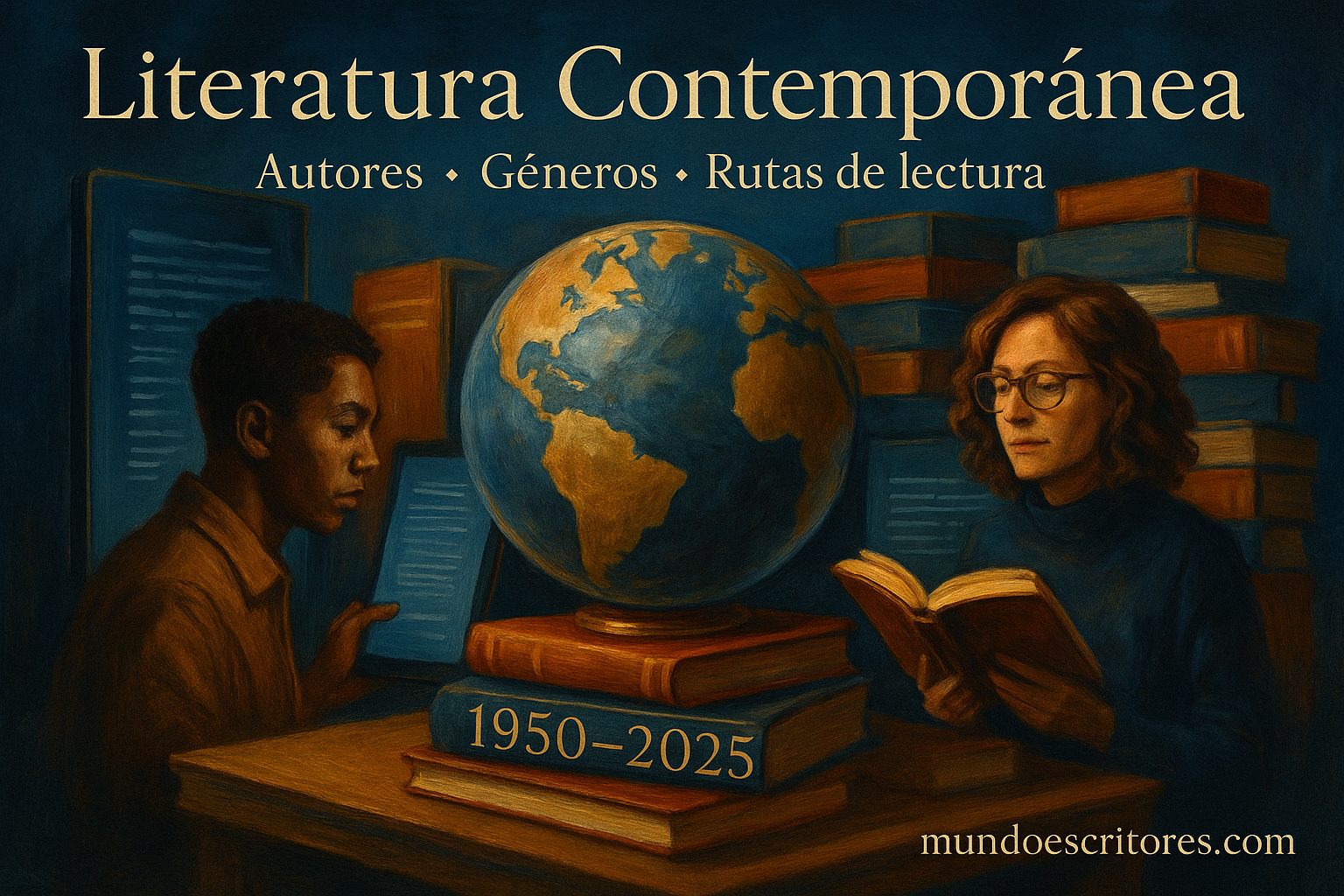
I come to this territory with the dual perspective of reader and author. I am Stevenson Jacques—Steve the poet—and my life's journey (from Haiti to Chile, from Creole to Spanish) has taught me that contemporaneity is not a date but an experience of constant translation . The first time I read Julio Cortázar, I felt that Spanish could twist reality; later, with Isabel Allende, I realized that an intimate story could become collective; and upon entering the urban darkness of Mariana Enríquez, I understood why gender labels are porous. This article stems from that nomadic reading and is intended as a foundational page that organizes paths and links to pieces already published on the Poets and Writers page.
Throughout the text you will find internal links to biographies and movements already covered —for example, Pablo Neruda , Javier Marías , Paulo Coelho , Literature of the Self and Detective Fiction— so that you can jump between authors ↔ works ↔ movements without losing the thread.
Contemporary Literature: Definition and Scope
What do we mean by “contemporary literature”?
In operational terms, we will call contemporary literature the body of works published from the mid-20th century to the present , within a context marked by the postwar period, decolonization, the digital revolution, transnational circulation, and the expansion of cultural industries. It is not a single style, but rather an umbrella term encompassing multiple poetics and reading markets.
Features that define it:
- Hybridization: mixture of genres (novel-essay, chronicle-fiction, poetry-prose).
- Distrust of the single narrative: polyphony, marginal voices, fragmentary memory.
- Self awareness: metaliterature, narrators who reveal the inner workings of the text.
- Globalization: mass translations, festivals, awards and platforms that accelerate circulation.
- Technology: writing and reading in digital environments; reading communities that recommend, discuss and canonize.
In our publishing house, this umbrella coexists with 19th-century literature, the historical "hinge" that explains many current procedures, including Isabel Allende or Manuel Puig , who exemplify divergent paths towards contemporaneity.
Key formal characteristics (with a reading compass)
- Polyphony and mobile point of view
Narratives that alternate voices (first/third, letters, chats, files). In the Hispanic world, this flexibility is perceived from Cortázar even the pieces of Mariana Enriquez. - Temporary rupture
Anachronisms, memory, and the present overlapping. If you've just read Gustave Flaubert (Published) or Shakespeare – Works (Published), you will notice that contemporaneity intensifies that break and makes it part of the meaning. - Autofiction and the “expanded self”
When biographical experience feeds into fiction without dissolving it. This subfield engages with our main pillar. Literature of the self (Next), where we map diaries, memoirs, and intimate essays. - Hybrid genres and remixes
The detective story becomes social or metaphysical; science fiction becomes political dystopia; the chronicle adopts techniques of the novel. For comparative examples, jump to Detective fiction. - Language and territory as policy
Translation, migration, and bilingualism rewrite poetics. As a migrant author, I recognize my own practice here: writing in Spanish, after Creole, was a form of contemporaneity.
Periodization of work (1950–present)
- 1950–1970: consolidation of the post-war period, Latin American boom (crossable with Julio Cortazar y Pablo Neruda.
- 1970–1990: postmodernism, minimalism, rise of Black and metaliterary experiments, see Manuel Puig.
- 1990–2010Globalization, the internet, the expansion of independent publishers; the emergence of new female voices, connects with Isabel Allende.
- 2010–2025: radical diversity, autofiction, true crime, technological dystopias, Latin American horror, see Mariana Enriquez.
Trends and currents (global map, 1950–to present)
So-called “contemporary literature” is not a list of trends, but a living system of interconnected currents. Below, I offer a practical map—organized by region and form—with reading paths linked to works already published on the site or marked as forthcoming.
Latin America: From the Boom to New Shores
- From formal experiment to the global city. The legacy of the Boom (Cortázar, García Márquez, Vargas Llosa) coexists today with urban, mixed, and autofictional writing. You can now jump to [the next section/topic] on the site. Julio Cortázar — biography and works and, as a counterpoint of intimate sensitivity, Mario Benedetti — biography and works.
- Memory, bodies and the ominous. Social horror and everyday fantasy are consolidated: Mariana Enriquez It's an ideal gateway.
- Poetics of testimony and the political. The tradition of the chronicle and the civic poem finds its anchor in Pablo Neruda and it is updated in hybrid writings (chronicle-novel, diary-fiction).
- For bridge to the 19th century and its formal roots, review 19th Century Literature.
Anglophone world: postmodernism, noir and autofiction
- Postmodern legacy. The novel that reflects on its own construction persists, but with a more legible surface: Paul auster It condenses chance, identity, and the city as a destination.
- Noir and a renewed “hard-boiled”. From classic detective stories to psychological and social thrillers; engage in dialogue with our guide Detective fiction.
- The confessional wave. Autofiction and memoirs expand the self (see Literature of the self.
Francophone and Lusophone: of new Roman to tropical mixes
- France It transitions from experimentalism to autofiction; Samuel Beckett It will function as a minimal genealogy of dispossession.
- Brazil It projects spirituality and popular parable in the key of best sellers: Paulo Coelho as a case of global circulation.
Mediterranean and Central Europe: Tradition, Trauma and Experimentation
- Spain It crosses tradition, memory, and metaliterature: Javier Marías It is a beacon of style and moral ambiguity.
- Italy (from Elsa Morante to Elena Ferrante) shows a powerful arc of intimate and social memory.
Africa and Asia: multiple modernities
- Africa It reconfigures nation, language, and diaspora; the postcolonial axis engages in dialogue with our Literatures by region.
- Asia combines tradition and avant-garde (line Universal Japanese writers y Contemporary Chinese writers,
Cross-cutting themes and mutating forms
- Autofiction and personal archives. The “self” as a laboratory (connection: Literature of the self.
- Historical memory and violence. From dictatorships and exiles to urban violence; natural links: César Vallejo for the ethics of the word; Manuel Puig for counterculture and cinema.
- Social and fantastical horror of proximity. Line Mariana Enriquez.
- Expanded Noir and true crime. Go deeper into Detective fiction.
- Metaliterature and living libraries. Books as characters (echoes with Javier Marías.
- Language and migration. Bilingual writing and translation as poetics (my own transition from Kreyòl to Spanish resonates in this section).
Reading routes (fast itineraries)
- City and destination → Paul auster → Javier Marías → Detective fiction..
– Direct reference: Javier Marías. - Memory and testimony → 19th Century Literature → César Vallejo → Gabriela Mistral.
- Horror and intimacy → Mariana Enriquez → Julio Cortazar → Literature of the self.
- Spiritual bestseller → Paulo Coelho → comparative map of parable/allegory in global narratives.
Market, platforms and formats (how contemporary culture circulates)
- Mixed industry: Large groups and independent publishers; catalog rescues and “new voices”.
- Festivals and awards: mobile canon, with specific awards by region/theme.
- Platforms: Audiobooks and e-books are reshaping habits; criticism coexists with reading clubs and online curation.
- Traducción: A high proportion of what is read outside the English-speaking world arrives mediated by translators; the figure of the author-translator is growing.
To continue exploring
- If you're interested in the metamorphoses of the self, save this guide.: Literature of the self
- To map the crime genre and its intersections with social criticism, go to Detective fiction.
- If you prefer the long genealogy that explains many contemporary resources (anachronisms, social realism, modernism), check out 19th Century Literature.
- and if you are looking for Latin American leading authors, jump to Pablo Neruda, Gabriela Mistral, César Vallejo, Julio Cortazar.
Hybrid genres of the present (clear guide + internal links)
Contemporary literature is defined less by rigid schools than by functional blends : the autobiographical intersects with the chronicle, the detective story expands into social critique, and the fantastic borders on political allegory. Below, I map the most active hybrids, with micro-definitions, techniques, examples, and internal shifts. I integrate my experience where it contributes to the reading experience and credibility.
Autofiction (the expanded self that creates fables)
- What is it: A story that uses autobiographical material with freedom of invention (it does not seek to "prove" facts, but to reflect on the experience).
- Techniques: mobile first person; diaries, emails or notebooks; montage of archival scenes.
- Internal bridges: When I edited testimonials for Mundo Escritores, I found that the self gains strength if it is assembled (scenes + documents), it's not just "told." This formal ethic engages with the refined style of Javier Marías.
Continue reading: Literature of the self: the intimate voice
Docufiction and chronicle-novel (facts with narrative breath)
What is it: verifiable materials (trials, press, interviews) narrated with tools of fiction.
Techniques: Multiple voices, archival work, "street-level" scenes.
Internal bridges: For a Latin American genealogy, the critical nerve comes from César Vallejoand the intimate-social tone continues in Mario Benedett.
Thriller social / Black global (crime as a snapshot of the world)
What is it: The classic police case is replaced by a focus on power structures (corruption, inequality, migration).
Techniques: unreliable narrators, urban cartographies, subplots of denunciation.
Internal bridges: general framework in Detective fiction: authors and works that defined the genre.
As an author, in workshops I usually ask for a "trigger object" (ticket, photo) to connect plot and subtext: a method I inherited from my readings of Paul auster.
Fantastic, close-up, and social horror
What is it: unsettling intrusions into everyday settings; the metaphor reveals tensions of class, gender or state violence.
Techniques: controlled ambiguity, atmosphere, verbal economy.
Internal bridges: ideal route with Julio Cortazar and its contemporary reinterpretation in Mariana Enriquez.
As a migrant, I recognize in this hybrid the way in which the unknown filters into the everyday: it was one of my keys when going from Creole to Spanish.
Dystopia and speculative fiction based on reality
What is it: possible worlds that take current trends to extremes (surveillance, climate, biopolitics) to think about the present.
Techniques: world building sober, integrated technical vocabulary, intimate focuses in altered societies.
Internal bridges: compare the precision prose with Gustave Flaubert (the clarity of the sentence sustains complex worlds).
Spiritual Parable and Symbolic Realism (best seller with ideas)
What is it: accessible stories with allegorical architecture; initiatory journeys, ethical dilemmas.
Techniques: fable structure, archetypal motifs, short chapters.
Internal bridges: Paulo Coelho.
Editorial Board: maintain a key symbol (stone, notebook, route) so that the reader anchors the meaning.
Family saga and historical memory (private voice ↔ public history)
What is it: Lineages and houses as microcosms of a nation; testimonies of women and diasporas.
Techniques: flexible chronology, choral voices, family documents.
Internal bridges: Isabel Allende and its transition from intimate narrative to collective memory.
Readable metaliterature (the book thinks about the book)
What is it: plots where writing/reading is the conflict; libraries, manuscripts, double authors.
Techniques: self-referential narrators, covert quotations, archives.
Internal bridges: Paul auster and the narrator's moral examination in Javier Marías.
Reading paths by levels (entry → intermediate → advanced)
Objective: to offer clear itineraries to guide the reader, linking previously published articles and anticipating upcoming ones without overlaps.
Route A — City, chance and identity (New York as a laboratory)
Entry
- Paul auster — gateway to the city-board and narrative randomness.
- Julio Cortazar — play and everyday strangeness.
- Context: Works by William Shakespeare — masks and identity.
Intermediate
- Javier Marías — moral ambiguity and inner city.
- Manuel Puig — pop, desire and film montage.
- Gender framework: Detective fiction.
Advanced
- Comparative readings of urban cycles (late Auster / late Marías).
- Closing essay: city-character.
- Technical rereading (point of view / time): 19th Century Literature.
Route B — Memory, testimony and lineage
Entry
- Isabel Allende — family saga and women.
- Mario Benedetti — civil love, exile, and everyday ethics.
- Pablo Neruda — civic poetry and testimony.
Intermediate
- Gabriela Mistral — motherhood, faith and pain.
- César Vallejo — radical compassion and the rupture of verse.
- Marco: Literature of the self.
Advanced
- Cross between chronicle and novel (Latin American docufiction).
- Family archive workshop (curation / album / letters).
- Canonical Bridge: Works by Miguel de Cervantes.
Route C — Proximity fantasy and social horror
Entry
- Julio Cortazar — fantastic commuter rail.
- Mariana Enriquez — cities, bodies and rituals.
- Comparison with Detective fiction.
Intermediate
- JJuan José Arreola — fable, irony, and moral miniatures.
- Manuel Puig — game of masks and desire-
- Essay: the fantastic as social criticism — (Next).
Advanced
- Historical dossier: from Romanticism to the present → Lord Byron.
- Toolbox (atmosphere / ambiguity / point of view) — (Next).
- Conversation with auteur horror cinema — (Next).
Route D — Spiritual Parable and Symbolic Realism
Entry
- Paulo Coelho — initiatory journey and symbol.
- Isabel Allende — domestic myth and affective memory.
- Bridge-poetry: Pablo Neruda.
Intermediate
- Comparative readings (allegory vs. parable) — (Next).
- Symbol Workshop (key object in 3 acts) — (Next).
- Reception (clubs, audiobook, fairs) — (Next).
Advanced
- Global circulation mapping (translation / awards).
- Critical debate on spirituality and the market.
- Historical link: 19th Century Literature.
Industry, awards and global circulation
Contemporary literature is also understood by how it circulates: agents, publishers, fairs, awards, translation, reading clubs and digital platforms reconfigure what is read and why.
1) How books travel today: from manuscript to reader
Agents and scouts. They mediate between author and publisher; they place works in international catalogs and negotiate rights.
Editorials. Large groups (global reach) coexist with independent labels (aesthetic risk, discovery of new voices). In Latin America, it's common to move from an independent label to a multinational one to achieve international success.
Fairs. Frankfurt, London, Bologna (children's/youth) and FIL Guadalajara coordinate rights purchases and media focus.
Platforms. E-books and audiobooks extend the catalog's lifespan; discovery through algorithms, reviews, and communities (BookTok/Bookstagram) is already impacting the new canon.
Cases to look at real circulation: Paul Auster : novel, essay and film; Isabel Allende family saga with global reach.
2) Translation as an infrastructure of prestige
To translate is to rewrite: sets tone, register and rhythm; in non-English-speaking markets, it determines visibility.
Bridge languages. Spanish ↔ English/French/German; print runs and awards usually depend on a first major translation.
Author-translator. The figure of the writer who translates or supervises is growing, reinforcing their authorial identity.
From World WritersI've seen "correct" stories take off after a good translation: it's not just about switching languages; it's fine tune a poetics for another ear.
3) Awards that shake things up (visibility and catalog)
Nobel (trajectory and universal contribution) reorders catalogs and school programs.
Booker / International Booker They promote circulation in English and translation.
Cervantes Prize It gives a prestigious umbrella to the Spanish language.
Goncourt, National Book Award, Planeta / Herralde / Alfaguara: each one pushes genres and trends.
Cross-references with published works: Pablo Neruda — Nobel 1971 and Gabriela Mistral — Nobel 1945.
4) Readers, criticism and networks: who builds the “new canon”
Professional criticism and academia They build legitimacy and bibliographies.
Reading communities (clubs, newsletters, podcasts) recommend and support long sellers.
User content (clips, short reviews, viral quotes) reactivates background catalogs.
Critical reissues (prologues, notes) function like canon machines.
5) An ecosystem with tensions (and opportunities)
Overproduction vs. discoverability. Solution: thematic curations and useful reading paths.
Attention gap. It favors short stories, novellas, and chronicles/essays.
Diversity and canon repair. More female voices, dissidence, and linguistic peripheries.
Editorial data. Reading metrics (dropout, completion) influence what gets published and reprinted.
Frequently Asked Questions (FAQs) + Closing with reading paths
A body of work from the mid-20th century to the present, characterized by genre hybridization, global circulation, and digital reading. For its immediate genealogy: 19th-century literature.
Autofiction, docufiction/chronicle-novel, noir /social thriller, local fantasy, dystopia, and symbolic parable. See Crime Fiction and Autofiction.
Paul Auster — chance, identity and city; Hispanic counterpoint: Javier Marías.
Pablo Neruda and César Vallejo in emotional and social narrative: Mario Benedetti.
Isabel Allende for a pop and cultural archive perspective: Manuel Puig.
Yes: technique and themes engage in dialogue across distances. Review the works of William Shakespeare , Miguel de Cervantes , Gustave Flaubert , and Homer.
Closing: What to read based on your interests
- City, chance and identity: Paul auster y Javier Marías.
- Fantasy and social horror: Julio Cortazar y Mariana Enriquez.
- Family memory and saga: Isabel Allende historical context in 19th Century Literature.
- Narrative self and debates of the present: guard Literature of the self and returns for new routes.

Stevenson Jacques, originally from Haiti, is a professional electrician , theater actor, poet, writer, and art lover, known as "Steve the Poet." I am the founder of "World Writers." For years, I have been publishing on my social media. I have also published in several anthologies, one of which is Champurria. After so many years of sporadic publishing, I decided to publish my first poetry collection, "Tomb Flower," in two languages: Haitian Creole and Spanish, as well as a novel, "Depi Nan Benbo." I plan to publish another novel soon, and much more.
After so many years of sporadic publishing, the poet decided to publish a poetic novel, "Depi Nan Benbo," and his first book of poems, "Flor De Tumba – Flè Kav," in two languages: Haitian Creole and Spanish. It is a book of short poems and free verse.
She plans to publish a novel soon, and much more.