

Gabriela Mistral: biography, works and legacy of the universal Chilean poet
Introduction
To speak of Gabriela Mistral is to evoke the voice of a woman who transformed poetry into an act of tenderness and resistance. Born in Chile as Lucila Godoy Alcayaga , she was the first Latin American writer to receive the Nobel Prize in Literature in 1945, an award that established her as a pioneering figure in world literature.
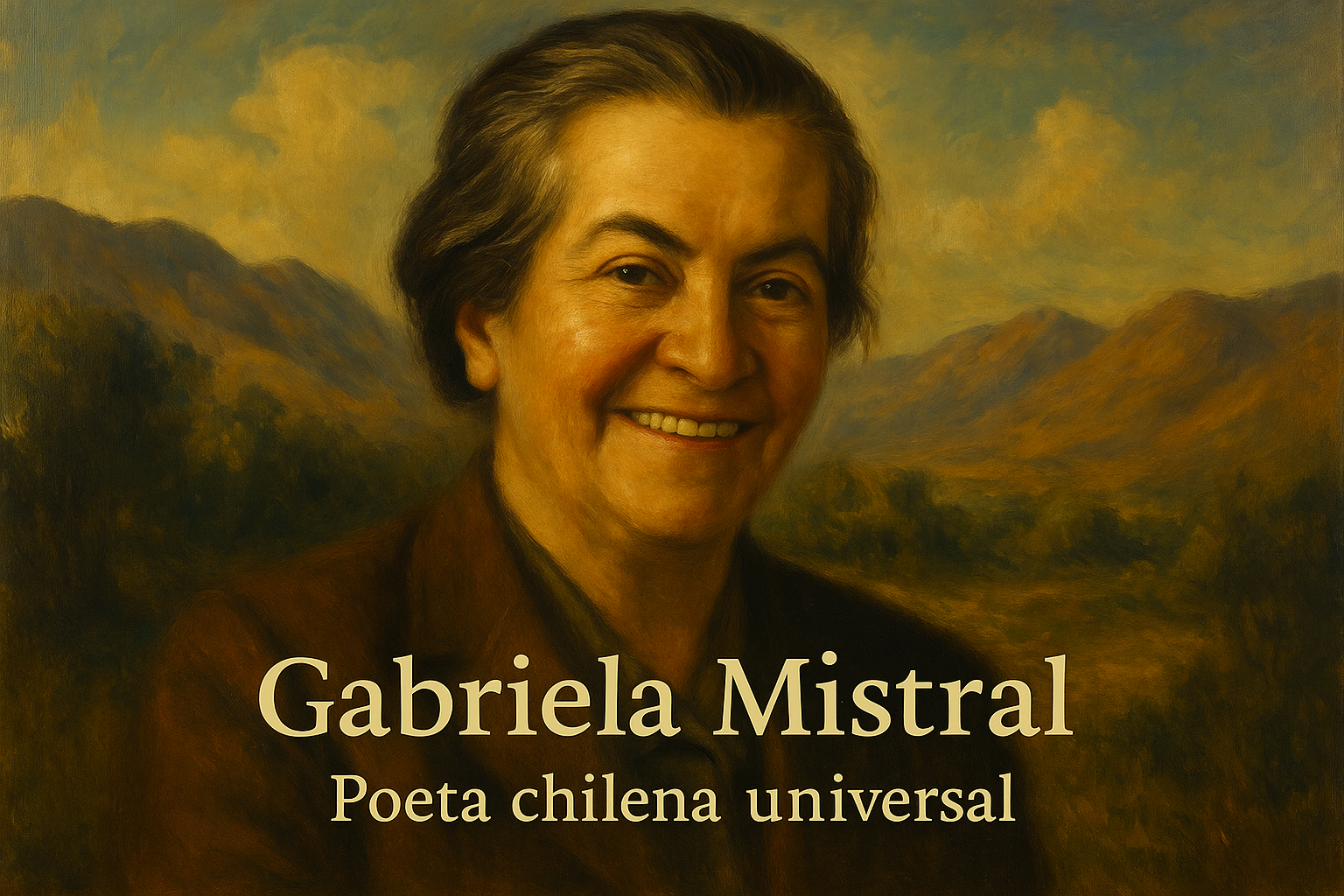
Mistral was, in addition to being a poet, a teacher, educator, and diplomat . Her work engages with the great human themes: motherhood, love, faith, loss, and social justice. From the intimate verses of Desolation to the luminous hope of Tenderness , she crafted a poetry that touched both children and adults, transcending borders and generations.
On this page we will explore his life, his most outstanding books, his literary style and the mark he left on Latin American culture.
See more at Latin American Poets.
Biography of Gabriela Mistral
Childhood and education in Chile
Gabriela Mistral was born on April 7, 1889 , in Vicuña, a small town in the Elqui Valley in northern Chile. Her childhood was marked by poverty and the abandonment by her father, a rural schoolteacher who left home when she was very young. However, her mother and older sister encouraged her to pursue an education and develop her artistic sensibility.
From a young age, she worked as a teacher in rural schools, where she came into direct contact with the realities of childhood and marginalization. This experience would forge one of the constants of her work: the defense of the child as a symbol of purity and hope.
Career as a teacher and educator
In 1904, she began publishing her first texts in the Chilean press, signing with the pseudonym "Gabriela Mistral," inspired by the poets Gabriele D'Annunzio and Frédéric Mistral . Shortly after, she gained recognition in literary competitions with poems that reflected both her inner world and her pedagogical vocation.
Her work as a teacher took her to various parts of Chile, and she soon became a respected voice in the country's educational debates. In 1922, she was invited to Mexico by the government of José Vasconcelos to collaborate on educational reform , where she actively participated in literacy projects and rural schools.
More details about his pedagogical contribution will be in Latin American Literature and Education.
Biography of Gabriela Mistral (continued)
Diplomacy and international life
Gabriela Mistral's literary and pedagogical acclaim soon led her to diplomacy. In 1925, she joined the Chilean consular service, serving as consul in cities such as Madrid, Lisbon, Naples, Petrópolis, and Los Angeles. Through these missions, Mistral represented not only her country but also Latin American culture as a whole.
During those years, she cultivated friendships with intellectuals such as Victoria Ocampo , José Vasconcelos , and Pablo Neruda , with whom she maintained a complex dialogue characterized by both respect and distance. Her role as a diplomat also served as a platform for disseminating her poetry and for advocating for the most vulnerable, especially children and women.
Mistral's international career solidified her place as a globally prestigious cultural figure, long before she received the Nobel Prize.
See more about Pablo Neruda.
Last years and death
In 1945, Gabriela Mistral received the Nobel Prize in Literature , becoming the first Latin American woman to do so. The Swedish Academy highlighted the “lyrical emotion inspired by powerful feelings” in her work, as well as her ability to reflect the essence of life in her poems.
Following the award, her international profile grew even more. She continued working as a consul and traveled to various countries, always active in conferences, publications, and literary collaborations.
Her final years were marked by illness: she suffered from diabetes and pancreatic cancer. She died on January 10, 1957, in Hempstead, New York. She was honored in Chile, where thousands of people paid their respects as a symbol of national and continental identity.
More information about its global impact will be in the Nobel Prize for Literature.
Works by Gabriela Mistral
Gabriela Mistral 's poetry unfolds in a vital and aesthetic journey that ranges from intimate desolation to luminous tenderness. Her books reflect both her personal experience and her social and pedagogical vocation. Each work marks a stage of maturity and commitment to the poetic word.
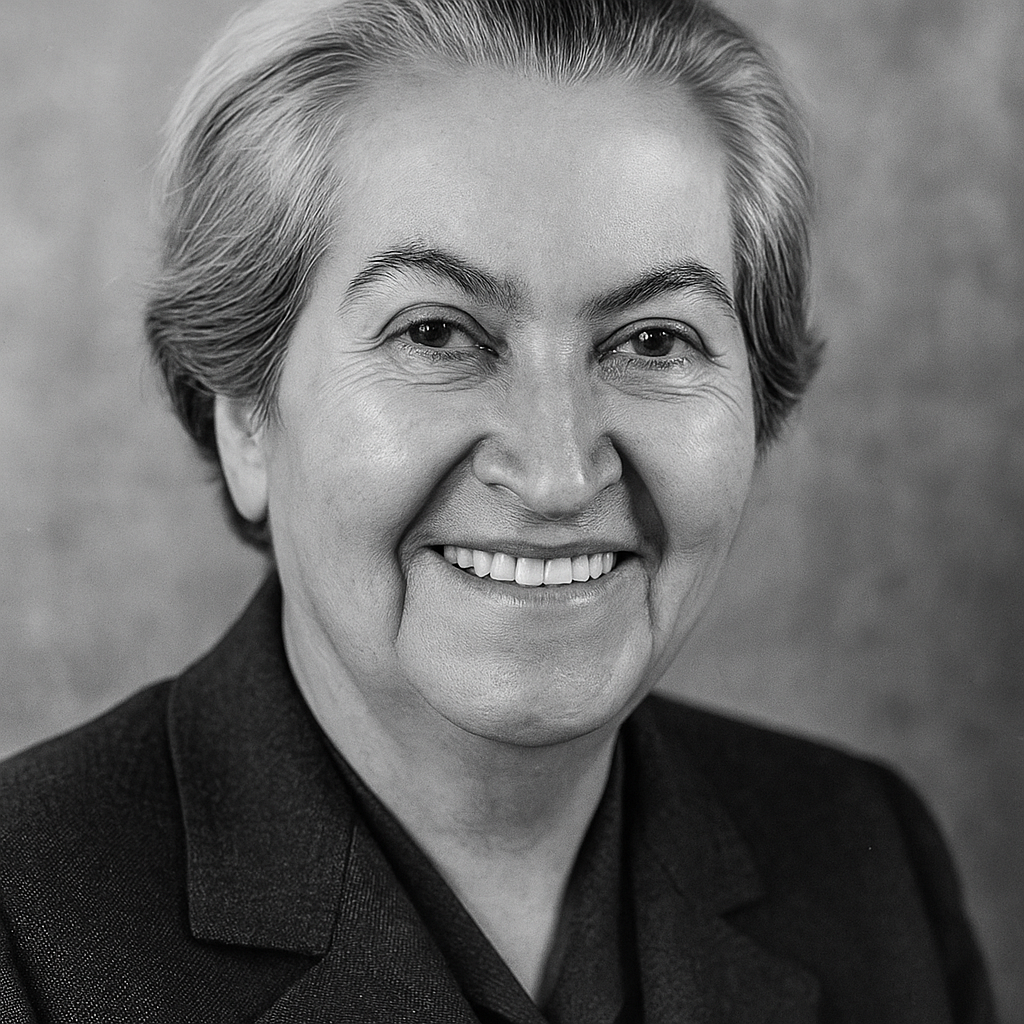
Bleakness (1922)
Published in New York, this was her first major book and the work that brought her international acclaim. It brings together poems written since her youth, imbued with pain, loneliness, and a spiritual quest. The death of the young Romelio Ureta, her first love, set the elegiac tone for several of the poems.
Success Bleakness She established her voice as one of the most powerful in Latin America at the beginning of the 20th century.
see more at Works by classical poets and writers.
Tenderness (1924)
This book represents a luminous turning point in her poetry. Tenderness is dedicated to children and brings together lullabies, nursery rhymes, and verses of touching simplicity. Here, Mistral becomes the poet of childhood , championing the value of childhood as a hope for the future.
Its influence on the Latin American children's literature It is undeniable, as it paved the way for poetry to also be a pedagogical tool.
see more at Latin American Literature and Education.
The station (1954)
Published in her later years, Lagar is a mature book of great symbolic density. Grief, faith, and reflection on human destiny appear here. The poet confronts death and pain, but does so with a serene voice, seeking reconciliation with the transcendent.
En The stationGabriela Mistral demonstrates the maturity of a writing style capable of confronting darkness without losing ethical clarity.
see more at 20th Century Literature .
Individual poems and anthologies
In addition to her major books, Mistral published scattered poems in magazines, anthologies, and posthumous editions. Among these, Poema de Chile and Recados stand out , where she delves deeper into her vision of nature, her homeland, and spirituality.
These publications reinforce her place as a universal poet, whose work engages with both the intimate and the collective.
Gabriela Mistral and the Nobel Prize in Literature (1945)
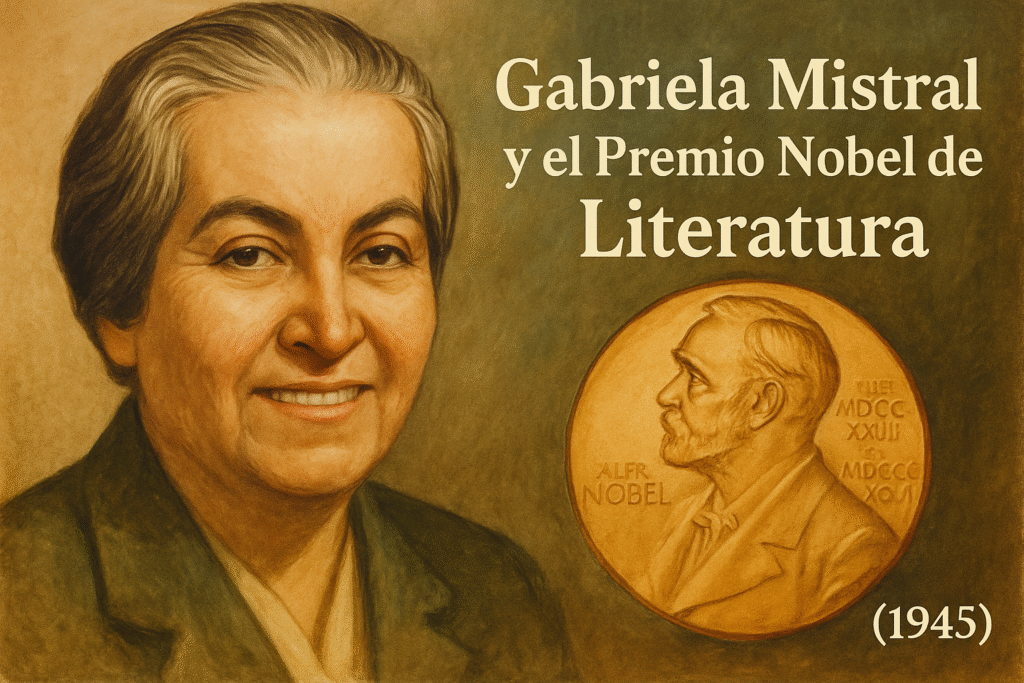
In 1945 , the Swedish Academy awarded Gabriela Mistral the Nobel Prize in Literature , making her the first Latin American woman and the first Chilean author to receive this distinction. The jury recognized “her lyrical work, inspired by powerful feelings, which has made her name a symbol of the idealistic aspirations of the entire Latin American world.”
The award came after more than two decades of work as a poet, educator, and diplomat. The news was celebrated throughout the continent, not only as recognition of her work, but also as a triumph for Latin American literature.
In her acceptance speech, Mistral celebrated her humble origins, her Latin American identity, and the importance of childhood and education as central to her life and poetry. She presented herself not as an individual figure, but as a voice representing millions of women, teachers, and peoples of the Global South.
This Nobel Prize not only strengthened his position in world literature, but also paved the way for other authors from the region to receive the same honor in later decades, such as Pablo Neruda , Octavio Paz , and Mario Vargas Llosa.
More on this topic in Nobel Prize for Literature.
Literary style and main themes in the work of Gabriela Mistral
Gabriela Mistral 's poetry is characterized by a lyrical style, imbued with musicality and emotional depth. Her language combines simplicity and symbolism, allowing her to reach both popular readers and specialized critics. Throughout her career, she cultivated a poetic voice in which tenderness, pain, faith, and social commitment coexist.
Childhood and motherhood
Childhood occupies a central place in her work. In Ternura , Mistral writes for children with nursery rhymes and lullabies that celebrate innocence and hope. Her vision of motherhood goes beyond the biological: it is a universal symbol of care and protection.
More on this approach in Latin American Literature and Education.
Pain and loss
The experience of the early death of her first love, Romelio Ureta, indelibly marked her early poetry. In Desolation , the poet explores loneliness, anguish, and the search for spiritual solace. This elegiac tone gave her a unique voice within Latin American literature.
See also Latin American Poets.
Faith and spirituality
Gabriela Mistral drew from a profound spirituality, a blend of Catholic tradition and a universal vision of humanity. Her poems speak of God, transcendence, and the mystery of existence, but always from a lived and personal perspective.
This aspect distinguishes her from contemporaries such as Alfonsina Storni , whose work leaned more towards social feminism than towards the spiritual.
Social and educational commitment
Beyond the personal and the religious, Mistral understood poetry as a service to the community. Her advocacy for public education, the dignity of children, and social justice is reflected in both her pedagogical writings and her poetry. She was one of the first Latin American intellectuals to propose that literature should engage in dialogue with society and contribute to its transformation.
To expand on this topic, see Contemporary Literature.
Influence and legacy of Gabriela Mistral in Latin American literature
Gabriela Mistral 's figure transcends the boundaries of poetry to become a cultural and social symbol of Latin America. She was the first woman from the region to receive the Nobel Prize in Literature , but her influence goes far beyond accolades: it lies in the way she inspired writers, educators, and readers throughout the continent.
Pioneer of the female voice in literature
Mistral paved the way for women in a literary field dominated by men. Her poetry, imbued with sensitivity and ethical strength, demonstrated that the female voice could be universal without losing its uniqueness. She inspired authors such as Alfonsina Storni and Juana de Ibarbourou , who, from different perspectives, also championed women's experiences in literature.
See more at Latin American Poets.
Influence on social and educational poetry
Her commitment to education and childhood left its mark on later generations. Writers like Mario Benedetti embraced her expressive simplicity to speak of everyday life, while Pablo Neruda engaged with it through epic and political themes. For Mistral, poetry was not an aesthetic refuge, but an instrument for social and cultural life.
More about Benedetti at Mario Benedetti.
Cultural and universal legacy
Mistral's work continues to be read, studied, and celebrated worldwide. Her image appears on banknotes, in schools, and on monuments in Chile, as well as in academic programs and international tributes. She is remembered not only as a poet, but also as a teacher and diplomat, a woman who used words to bridge the gap between peoples and generations.
See more in Contemporary Literature.
Frequently Asked Questions about Gabriela Mistral
Gabriela Mistral (1889–1957), born Lucila Godoy Alcayaga , was a Chilean poet, teacher, and diplomat. In 1945, she became the first Latin American woman to receive the Nobel Prize in Literature , in recognition of her poetic work and her commitment to education and social justice.
His essential books are Bleakness (1922) Tenderness (1924) and The station (1954). Each one reflects a different stage of his life: pain, tenderness, and spiritual maturity. Posthumous works were also published, such as Poem from Chile.
see more at Works by classical poets and writers.
The Swedish Academy awarded her the Nobel Prize in 1945 for her lyrical work “inspired by powerful feelings,” which represents the idealistic aspirations of the Latin American world. She was recognized both for her poetry and for her social and educational work.
Her poetry addresses childhood, motherhood, love, faith, loss, and social justice. These themes make her a profoundly human and universal poet.
see more at contemporary literature.
Gabriela Mistral paved the way for women writers and solidified Latin American poetry on the world stage. Her legacy lives on in authors such as Pablo Neruda, Alfonsina Storni, and Mario Benedetti.
Explore more at Latin American poets.
Conclusion: Gabriela Mistral, the maternal and universal voice of Latin America
The life and work of Gabriela Mistral show that poetry can be both intimate and universal. From the sorrowful verses of Desolación to the luminosity of Ternura and the reflective maturity of Lagar , her voice never ceased to build bridges between the personal and the collective, between pain and hope.
Mistral was not only a poet: she was a teacher, diplomat, and children's rights advocate , someone who understood literature as a service to the community. She embodies the power of words to transform the social and cultural life of a continent.
Her Nobel Prize in 1945 established her on the world stage, but her true legacy lives on in every reader who discovers in her verses an echo of tenderness, spirituality, and human commitment. As a pioneer, she paved the way for other Latin American voices to find a place in world literature.
To further explore its context and connections, you can visit:
Gabriela Mistral remains a symbol of female strength in literature and one of the voices that best expresses the soul of Latin America. Her poetry continues to remind us that love, childhood, and justice are essential foundations of humanity.

I am Stevenson Jacques, originally from Haiti, a professional electrician , theater actor, novelist, poet, writer, art lover, known as "Steve the Poet".
In 2008 I began to work more in the world of art, writing and theater; I was part of several theater companies.
Since 2014 I have been a member of “Tanbou Literè”; a group of dynamic young people who love art and literature.
I published in the anthology "Champurria" in 2018, and in the literary magazine "Desvanecimiento" in 2022. I have participated in several writing workshops and literary courses.
I am a member of a very dynamic and committed group of Haitian writers of my generation, “REK”; They are activist writers in defense and appreciation of the Haitian Kreyòl language.
After many years of publishing sporadically, I decided to publish my first bilingual poetry collection, "flor de tumba – Flè kav," along with its accompanying audiobook, in January 2023. In the same year, 2023, I published a novel in Creole, "Depi nan benbo," which I had been working on for over six years.