
Independent bookstores: the refuge where books are still recommended face to face
In the face of fast shopping, algorithms, and large platforms, independent bookstores retain a cultural function that is difficult to replace: creating a reading community.
They are not just points of sale. They also function as spaces for conversation, discovery, literary mediation, and advocacy for bibliodiversity.
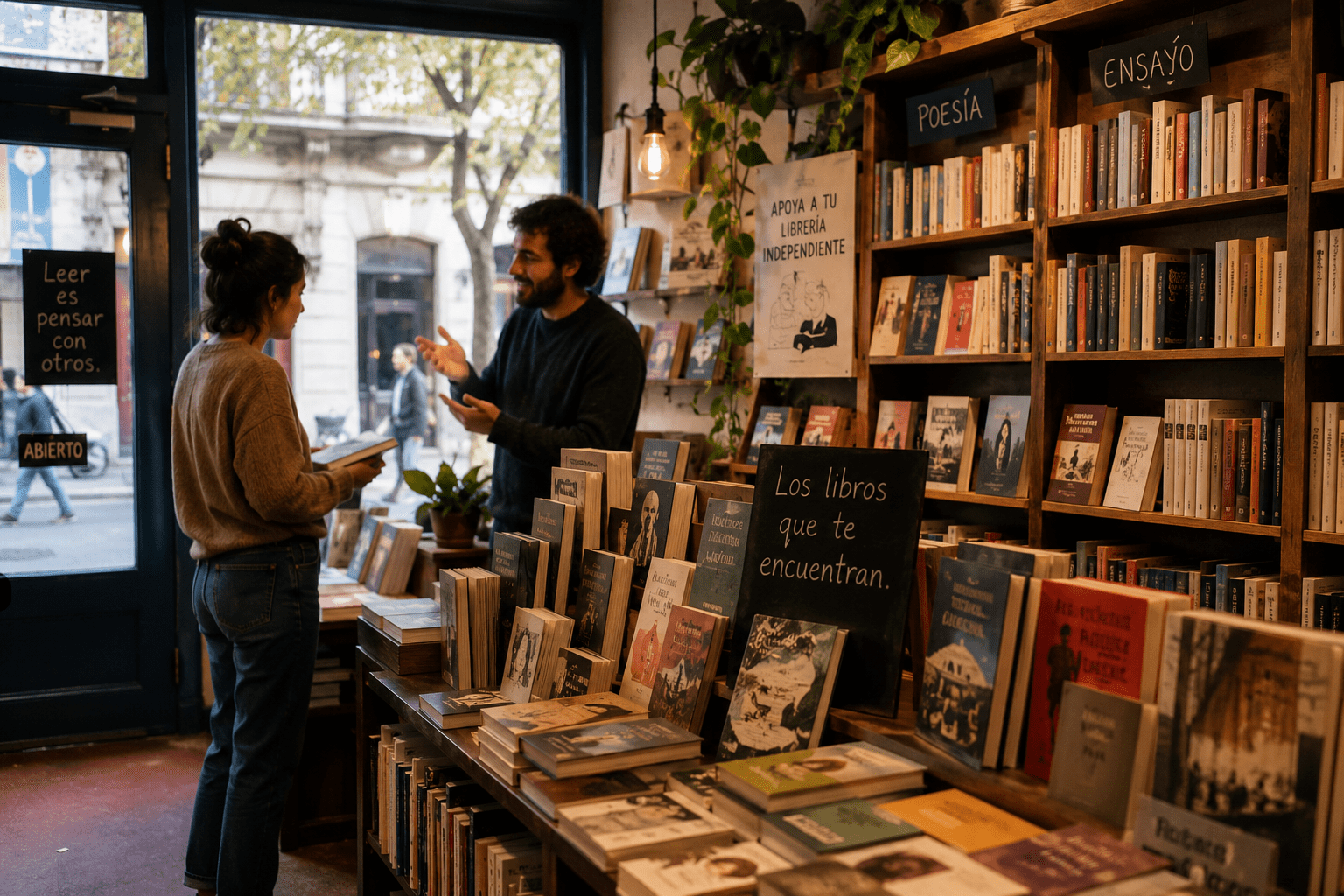
A bookstore doesn't just sell books: it creates community.
An independent bookstore isn't measured solely by its sales. Its cultural value appears in something less visible: the conversation between bookseller and reader, the table of new releases curated with their own discerning eye, the Thursday book club, the presentation of a local author, the book that someone buys because another person enthusiastically recommended it.
In an ecosystem dominated by platforms, search engines, and automated recommendations, independent bookstores offer a different experience. There, books aren't chosen solely based on consumption calculations, but through human interaction. The bookseller doesn't replace the algorithm out of nostalgia: they confront it with context, reading history, and knowledge of the neighborhood.
You might be interested in: Underlined books: the silent way readers converse with literature.
The bookseller as curator of unexpected readings
The role of the bookseller goes far beyond simply delivering a product. CEGAL, the Spanish Confederation of Booksellers' Guilds and Associations, points out that one of its challenges is to contribute to cultural enrichment through the efficient distribution of books, with special support for small and medium-sized independent bookstores as guarantors of cultural and ideological diversity. This same organization represents 1.100 bookstores in Spain.
That idea is key: an independent bookstore doesn't just curate a catalog, it also understands a community. It knows what its customers read, what's missing in the neighborhood, which local authors need a platform, and which books can circulate more effectively if someone puts them in the right hands.
Instead of the algorithm, a recommendation with a face.
Digital recommendations are often effective, but limited: they often focus on what has already been purchased, searched for, or resembled a previous preference. A bookstore recommendation can do something different: interrupt a book's established taste, spark curiosity, or suggest an unexpected book.
That difference matters because reading doesn't always progress through repetition. Sometimes a reader needs someone to tell them, "Try this book," even if it's not what they were looking for. That face-to-face recommendation fosters a kind of trust that no platform can fully replicate.
Bibliodiversity is also defended from a bookshelf
Independent bookstores are important for bibliodiversity. While large bookstores tend to focus on high-turnover titles, small bookstores can support catalogs of independent publishers, poetry, essays, plays, children's books by authors, local fiction, or translations that don't always find a place in mainstream circuits.
This defense doesn't only happen in public statements. It happens in small decisions: which book is placed on the front desk, which publisher is recommended, which local author is invited, which title is kept available even if it's not a new release. A bookshelf can also be a cultural statement.
See also: Rereading a book: why we return to stories we already know.
Bookstores that resist: living culture with fragile finances
The phenomenon isn't just sentimental. In the United States, the American Booksellers Association's 2024 annual report recorded an 18% growth in membership and the opening of 323 new independent physical, mobile, or pop-up bookstores that year. The association also noted that it was the fourth consecutive year with more than 200 new openings.
In Colombia, the Colombian Book Chamber presented its first study on bookstores in the country in March 2025. The analysis considered 205 bookstores and 444 points of sale in 54 municipalities, and recorded cultural activities such as book presentations, workshops, reading clubs, author signings, children's readings, concerts, and exhibitions.
The same Colombian study reveals the economic strain on the sector: the main problems cited by bookstores were low profit margins, competition from online platforms, high operating costs, book prices, and piracy. In other words, independent bookstores can be culturally strong and, at the same time, financially fragile.
Clubs, workshops and presentations: the bookstore as a meeting point
The UK Booksellers Association reported in 2024 that research on independent bookstores in England found evidence of the extent of their cultural and community activities. The organization highlighted their role in cultural enrichment, community engagement, fostering young readers, and supporting writers from diverse communities.
In its document "In Defense of Bookstores ," the Cerlalc argues that these spaces remain hubs of cultural and commercial activity, cornerstones of community life, and important places for democratic diversity. The report also notes that digital transformation has changed reading, research, and purchasing habits, but proposes strengthening bookstores both in their physical presence and their online presence.
Keys to understanding why independent bookstores matter
- They are spaces for sales, but also for cultural mediation.
- Human recommendation allows you to discover books outside the logic of the algorithm.
- They can support less visible catalogs: independent publishers, poetry, essays, theater, or local authors.
- They function as meeting places through reading clubs, workshops, presentations and community activities.
- Its cultural value coexists with economic challenges: low margins, operating costs, and digital competition.
- Strengthening them also strengthens bibliodiversity and the cultural life of the neighborhoods.
What's next: surviving without losing the conversation
The future of independent bookstores will depend on their ability to maintain a dual presence: physical and digital. They need online sales tools, social media, and up-to-date catalogs, but without losing what makes them unique: direct interaction, conversation, curated selection, and trust.
An independent bookstore cannot compete with a platform in terms of speed or stock volume. Its strength lies elsewhere: in remembering that a book isn't always found because someone searched for it, but because someone knew how to recommend it.

I am Betty, author and curator of this space. I work with the method Read · Distill · CountI read classic and modern versions, distillate the heart of the story and it story using clear language, respecting the original meaning and proposing values workable.
I prioritize public domain when appropriate and I point out the adaptation When I make it. On each piece I indicate edad y reading timeand when it adds value PDF, audio y comprehension questionsI update content regularly; if I make significant changes, I mark them on the page. If you notice anything that could be improved, please let me know: my goal is for every reading experience to be enjoyable. accompany y teach with rigor and warmth.