

Works by Pablo Neruda: twenty love poems, General sing and his poetic legacy
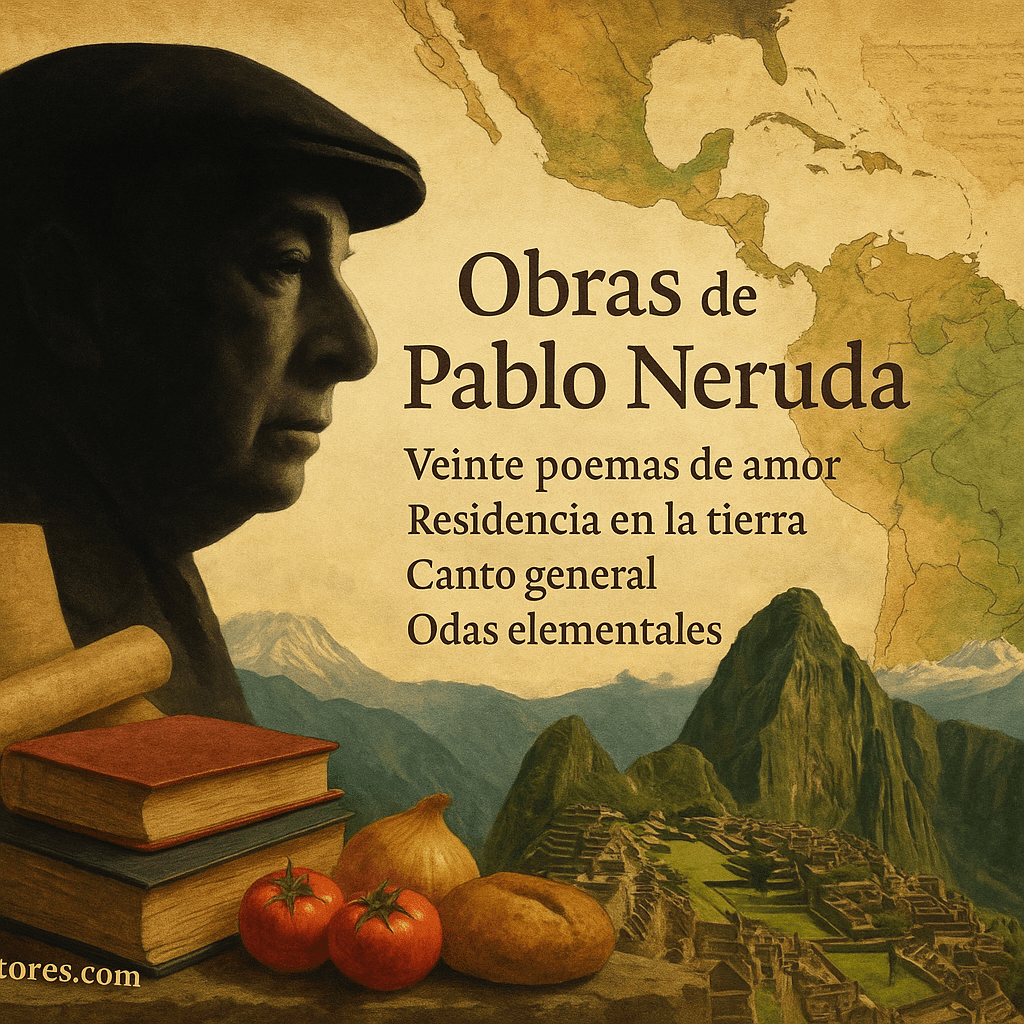
Reading Pablo Neruda is to enter a language that breathes: a voice that names both desire and the geography of a continent. In his early books, he speaks to us as a young man discovering love and its losses; in his middle works, as a poet inventing an epic of America; in his maturity, as a craftsman who brings poetry down to everyday things, making them unforgettable. This arc—from the self to the collective and from the collective to the intimate—explains why Neruda remains among the most widely read authors in Spanish.
As a reader and writer, I came to Neruda through two doors. The first was emotion: I underlined verses in Twenty Love Poems and a Song of Despair that seemed written for my own life. The second, through workshops and public readings, was Canto General : I saw how his language brings together history, territory, and memory in a single pulse. In my work with Mundo Escritores , this dual approach has allowed me to guide new readers: starting with love, continuing with epic poetry, and later, enjoying the clarity of the Elemental Odes . If you'd like a comprehensive biographical overview—and then return to this map of his works—you can consult our piece “Pablo Neruda: Biography, Works, and Legacy of the Chilean Poet.” And if you're interested in how he engages with his Andean contemporaries, comparing him to César Vallejo and Gabriela Mistral broadens the context.
This article focuses on four key works: Twenty Love Poems , Residence on Earth , Canto General , and Elemental Odes . For each, I will provide context, themes, formal resources, one or two key verses with commentary, and recommended editions, along with reading paths for different audiences. Furthermore, we will connect his work to broader periodizations—for example, the frameworks discussed in “19th-Century Literature: Realism, Romanticism, and Modernism in Key Authors” —to situate his innovations within the tradition and their echoes in later poetry.
My goal is for you to end up with a clear, enjoyable, and solid reading plan, whether you're looking for a first encounter with Neruda or a more conscious reread.
Essential overview: how to read Neruda today
Entry routes according to your interest
If you're drawn to love poetry , start with Twenty Love Poems and a Song of Despair ; its sensory diction and immediate musicality make it easy to access. If you prefer historical and political poetry , jump to Canto General , where the individual voice becomes a continental chorus. For an experience of language —dreamlike imagery, estrangement, modernity—visit Residence on Earth . And if you want to reconnect with the poetry of the everyday , the Elemental Odes are a school of clarity.
Creative stages in five lines
- Youthful Love (1920–1924): eroticism, absence, personified nature.
- Vanguard and unease (1933–1935): visionary images, syntactic rupture, city as labyrinth (Residence).
- Continental epic (1940s–1950s): history, geography, politics; the poetic voice becomes choral (General sing).
- Clarity of the everyday (1954–1957): celebration of objects and trades, ethics of proximity (Elemental Odes).
- Synthesis and memory: anthologies, speeches, autobiographical prose (I confess that I have lived).
Recommended editions and formats
- Critical edition or with introductory notes all with Twenty poems, Residence y General sing, in order to locate variants, dates and sections.
- Thematic anthologies for new readers (love; America; odes).
- Audiobooks and recordings of public readings: they help to recognize the Nerudian “breath”.
- Compare translations (if you read in another language) to notice how each version resolves metaphors and rhythm.
Twenty love poems and a desperate song (1924): Youth, Desire and Lunar Language

Why begin here? This book is the most natural gateway to Neruda: direct, sensory, and musical. The voice is that of a young man discovering love and loss; body and nature merge in tactile images (sea, forest, night) to express desire and absence. The final “desperate song” acts as a counterpoint: the self listens to itself after the shipwreck.
Context and reading keys.
Published when the author was just over 20 years old, it consolidates a diction that blends late modernism with a unique imagery, less precious and more visceral. Here, traits that will reappear throughout his work are established:
- Nature-character: The scenery doesn't help, speech (the sea as a breast, the night as a coat).
- Sensuality without solemnity: Flesh and memory create emotion.
- Internal music: parallelisms, repetitions and a phrasing that can almost be heard out loud.
Formal resources (in simple terms).
- Continuous sensory metaphor: linked images that activate touch/smell/color.
- Rhythmic parataxis: short, cumulative phrases that maintain the emotional pulse.
- Discrete anaphora: repeated beginnings that create cadence and memory.
Impact and enduring relevance. The book has transcended its time because it speaks a universal language—heartbreak—with imagery that anyone can relate to . That's why it works equally well in private reading and in public readings (classrooms, book clubs, events). If you want to place it within the author's life story, first review his biography to align dates and periods.
Editions and reading paths.
- Edition with brief notes: It helps to identify variants and original order.
- Audiobook or recorded reading: The musicality is greatly enhanced when sung aloud.
- "Love First" Route: starts with Twenty poems…then jumps to Elemental Odes to see the other side of intimacy (the everyday), and later it rises to the epic of General sing.
Mirror readings.
- If you are interested in lyrical intimacy From another record, compare it with Gustavo Adolfo Becquer.
- In the Andean counterpointobserve the torn self and the experimentation of César Vallejoo, and portfolio of works.
- If you want to follow the bridge to currentsThis book situates itself in the transition from the end of the century towards the renewals of the twentieth century, and the continuity foreseen in contemporary literature.
For readers in a hurry (3 poems to get started).
- A text by high sensory voltage (sea/wave/body).
- A poem by absence (shadow/silence/memory).
- La “desperate song” As a closing: read it aloud, completely, without interruptions, to grasp its emotional architecture.
Methodological note (my experience).
When I work with Twenty Poems… in workshops, I ask participants to select three images that couldn't be changed without damaging the poem; then we rewrite them in prose and return to the verse: the exercise reveals how music sustains meaning. This practice, which I first tried after my readings in Spanish in Chile, is often the turning point that transforms a casual reader into a poetry reader.
Residence on earth (1933–1935): Surrealism, Anguish and Modernity
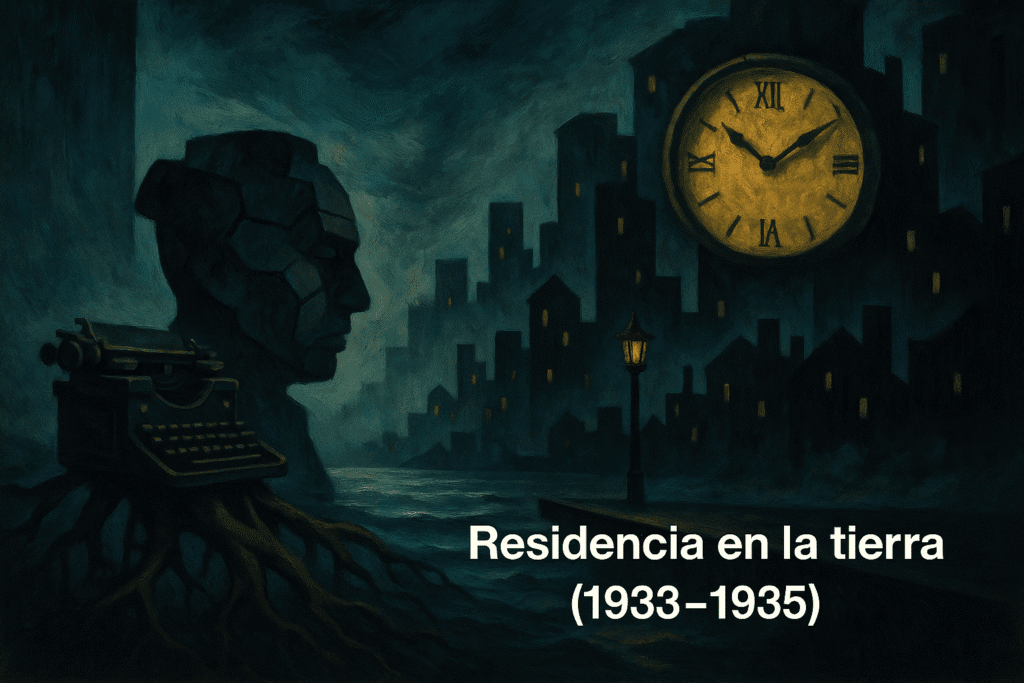
A change of atmosphere. After the sensory clarity of Twenty Poems… , Neruda ventures into a shadowy realm where the poetic self fractures and the world appears hostile or uninhabited. Residence on Earth doesn't "tell" emotions: it materializes them in unsettling images, dreamlike associations, and displaced syntax. It is the book that establishes Neruda within the great poetic modernity of the 20th century in Spanish.
Context and reading keys.
Written during years of diplomacy and displacement, the poems record the experience of the city as a labyrinth and of time as a viscous substance. The voice becomes less confessional and more visual : everyday objects change scale, the urban landscape becomes organic, and the body is perceived as part of a machinery of dream and wakefulness.
- Estrangement: the world is recognized by its mismatches (solid clouds, liquid houses, heavy shadows).
- Oblique syntax: Enjambments, unexpected turns, punctuation that stretches the breath.
- Dark semantic field: dust, rust, dampness, insects; the living mixed with the inert.
Why does it matter today? Because it teaches us to read reality in its fissures : modern experience—traffic, crowds, noise—demands a language that is not decorative but unsettling . In reading workshops I've led, I usually suggest starting with two or three poems and mapping out sensations before looking for a "theme": first, what the text does to the body, then what the body thinks of the text. This order prevents abstraction from devouring emotion.
Formal resources (clean version).
- Tectonic metaphors: One image displaces another like plates; there is no stable hierarchy.
- Anaphoric chains and chaotic enumerations: tidal rhythm that advances and recedes.
- Low-light prosody: predominance of low sounds, earthy and humid vocabulary.
Verses and critical reception. Critics have seen in *Residencia* a cross between surrealism, early existentialism, and urban chronicle. In readings aloud, I ask the reader to listen to the nominal series as if they were music: it is understood more by ear than by gloss. I avoid quoting long passages; the experience is enhanced when the reader discovers the "strike" of an image without any foreshadowing.
Editions and how to approach them.
- Choose edition with notes apparatus that points out variations between series and books.
- Read 2–3 poems per session, without Look for plot points; note down “impossible” images and unexpected relationships.
- Alternate with clearer texts from the same period to give your eyes a rest. A good contrast is found in the pages of César Vallejowhere the formal rupture has a different music and a different ethics of the pronoun.
Context and dialogue.
- In the reference biography that situates these years and their diplomatic trajectory: Pablo Neruda.
- To understand the historical continuity of linguistic innovations, consult Nineteenth-century literature: realism, romanticism, and modernism in key authorswhich serves as a prelude to the modernist and avant-garde explorations of the 20th century, see Literary avant-gardes of the 20th century .
- If you then want to return to one celebratory clarity Without sacrificing rigor, the natural season is Elemental Odeswhich we will discuss below, and which engages in dialogue with the literature of the everyday treated by other authors, for example, in prose, Mario Benedetti.
My practice with readers.
I've found that Residencia de Estudiantes works best when the reader keeps a sketchbook : on each page, they jot down five "impossibilities" and a dominant color. By the end of the week, these lists reveal a choreography : Neruda's syntax isn't confusing, it's kinetic . Seeing it dance on the page is the first step to understanding its logic.
General sing (1950): Epic of America and Collective Voice
The shift to a continental scale. If Twenty Poems… speaks of the self and Residence… disarms perception, Canto General assembles a choral voice that traverses the history, geography, and peoples of America . It is not a book: it is a verbal continent . Neruda articulates chronicle, song, elegy, and manifesto to narrate from mineral origins to contemporary struggles.
Architecture and essential sections. The work is organized into multiple cantos (editions vary), among which the following stand out:
- “The lamp on earth” y “Heights of Machu Picchu”: mythical foundation and ascent towards the voice of the dead who “ask for life”.
- “The Conquerors” y “The land is called Juan”: clash, exploitation, dignity of work.
- Songs dedicated to heroes and territories: a crossroads of biographies and landscapes (an emotional map of America).
Reading keys.
- Civil Epic: replaces the individual hero with the collective subject (peasants, miners, workers).
- Geology of languageStones, metals, and mountain ranges function as signs of memory.
- Embodied politicsThe complaint is not abstract; it becomes image, scene, body.
Why it matters today. Canto General conceives of America as a poetic and historical unity . In readings and workshops, I've seen that it works best if the reader enters through two doors :
- “Heights of Machu Picchu” autonomously (sections VII–XII): listen to the ascending rhythm and the invocation to the “mud dead” before glossing.
- A territorial song nearby (Chile, Peru, Mexico): recognizing names, trades and materials activates empathy and anchors the epic scale.
Formal resources (clean version).
- Orographic enumerations: lists of mountains, rivers, trades and minerals that construct a “verbal relief”.
- Apostrophe (direct invocation): summons the absent one and creates community.
- Long breathed verse: the syntactic flow sustains the feeling of collective march.
Reception and Impact. The book solidified Neruda's status as a public poet and a continental icon; its epic style influenced social poetics in the mid-20th century and fueled performative readings (music, theater, film). It also sparked debates : the tension between the lyrical voice and the political agenda. Reading it today allows us to discuss what poetry can and cannot do in contexts of violence and inequality.
Editions and reading recommendations.
- Prefer editions with notes that indicate variations and structure by edges.
- Alternate reading “Heights…” with contextual materials on Andean cultures to understand mythical and social layers.
- If you're looking for a biographical bridge, check out the profile. Pablo Neruda.
Workshop notes (my experience).
When I work on General Singing with groups, I propose two exercises:
- Poetic CartographyChoose 10 place names from the book and draw a map with minimal citations; the exercise reveals the geopoetic unit of the work.
- Collective voice: Read together fragments with apostrophes and enumerations. The ear discovers how the shared breath sustains the political meaning of the poem.
Elemental Odes (1954–1957): the poetics of the everyday
A turn toward clarity. After the intensity of love and the continental epic, Neruda attempts another radical approach: celebrating the commonplace . In the Elemental Odes , poetry descends from marble to the table and from myth to daily life . There is no renunciation of ambition: there is a different ethic. The poet takes humble objects—the onion, the bread, the tomato, the dictionary, the clock—and, by naming them with affective precision, teaches us to see.
Reading keys.
- Democratizing the topic: Greatness is not found in the extraordinary, but in the dignity of the useful.
- Transparent tongue: shorter verse, direct metaphor, accessible imagery; prosody that accompanies speech.
- Ethics of care: The ode is not an empty panegyric; it acknowledges the human work behind everything.
- Philosophy of proximity: The material world becomes a social bond (who sows, who cooks, who shares).
Why it matters today. In workshops with young readers, I notice that the Odes re-educate the gaze: they slow it down . We ask them to choose an everyday object—a cup, a key—and write in prose about its gestures, textures, and journeys; then we move on to free verse. This transfer shows that poetry is not inaccessible: it is attention . It was in this way that, after my first years writing in Spanish, I regained confidence: everyday language offered me a bridge that didn't demand solemnity, but rather listening.
Formal resources (clean version).
- Friendly anaphora: Repetition that organizes thought and guides the ear.
- Family comparisons: associations that do not exclude the reader (the onion as a “water rose”).
- Nearby apostrophe: the poem speaks a the thing and, through it, the one who uses or produces it.
- Functional enumeration: It details processes (kneading, cutting, sharing) to make the collective effort visible.
Indicative selection of odes.
- “Ode to Bread” / “Ode to the Onion” / “Ode to the Tomato”: triptych of the shared table; they read well aloud.
- “Ode to the Book” / “Ode to the Dictionary”: reflection on language as a common home.
- “Ode to Joy” / “Ode to Sadness”: emotional ethics without abstraction, with concrete images.
How to read them (short routes).
- Domestic route (to enter): Bread → tomato → onion. Three readings, one meal, one conversation.
- Language path (for writing): dictionary → book → to criticism (propose your own “ode to the footnote”).
- Social path (for thinking about the country): bread → salt → wine → work; map of trades and invisible hands.
Recommended editions and formats.
- Search editions with subject index (by objects/values) to build your own routes.
- Audiobooks or public reading recordings work very well: the ode breathe with your voice.
- If you work with students, alternate with short prose pieces of Mario Benedetti to compare shades of clarity and closeness.
A personal note. At Mundo Escritores presentations , I usually close with a reading of “Ode to Bread.” It’s not a small gesture: it reminds me that poetry doesn’t just console or protest; it also shares . In my journey between languages—from Creole to Spanish—the Odes taught me that every word can be nourishment if we carefully name what sustains life.
Other key books and further reading
Memoirs and prose
- I confess that I have livedMore than anecdotes, it offers keys to understanding literary periods and friendships. Use it as a compass to date stages and compare them with the poems discussed above. To pinpoint key moments in life, rely on... Pablo Neruda: biography, works and legacy.
Anthologies and selections
- Thematic anthologies (love, America, odes) work very well for routes based on interestsI recommend starting with an anthology of love (natural bridge from Twenty poems…and then a civic/continental (bridge towards General sing).
- Selection of speeches and public textsThey help to listen to the tone of Neruda beyond the poem, and they dialogue with our line of Modern and contemporary works.
Works in dialogue
- César VallejoAnother way to create tension in language and history, useful for contrast Residence on earth.
- Gabriela Mistral: affective pedagogy and ethics of closeness, in tune with the clarity of the Chamber.
- To locate genealogies and historical bridges: Nineteenth-century literature: realism, romanticism, and modernism in key authors.
Suggested fast track: Twenty poems… → love anthology → Residence (short selection) → General song (Heights + 1 territorial song) → Elemental odes (table, language, work).
Poetic legacy: Neruda's mark on Spain and Latin America
Aesthetic influence
- Music of the verse y sensory metaphor: consolidated a diction that many Hispanic American poets adapted to their own landscapes.
- Civil Epic: General sing It legitimized a choral voice that blends history, geography, and work; its echo appears in social poetry and reading performances in squares, theaters, and schools.
- Democratization of the topic: The Chamber They opened a path to look at the everyday with poetic dignity (object, trade, food).
Cultural projection
- EducationLove poems and odes are featured in high school and university curricula; reading them aloud continues to activate community.
- Music and cinemaSung versions, documentaries, and stage recreations keep their repertoire alive.
- Critical debate: the relationship between aesthetics and politics in General sing It invites us to think what can poetry do in the face of injustice.
FAQs about the works of Pablo Neruda
Why does Twenty Love Poems remain an ideal entry point?
Because its sensory and musical language makes the experience of love recognizable without losing poetic depth. It's straightforward for the new reader and useful for the advanced reader who studies rhythm and metaphor. If you're interested in the complete life story, review the biography first.
What distinguishes Canto General from other historical or civic works?
It transforms history into poetic material : geology, flora, trades, and popular voices form a collective subject . It begins with "Heights of Machu Picchu" and a territorial song to feel its architecture.
Where do I enter Residence on Earth if it intimidates me?
Read 2–3 poems per session, note down five “impossible” images , and listen to their prosody before glossing. Compare this with César Vallejo to perceive differences in music and syntax.
Which Odes should I read first to grasp the project?
“Ode to Bread,” “Ode to the Tomato,” “Ode to the Onion”: a domestic triptych that showcases ethics, community, and verbal precision. It then moves on to “Ode to the Dictionary” to consider language as a common home.
Is there a recommended reading order for exploring his work?
Yes, a balanced path is: Twenty Poems… → Elemental Odes → Residence on Earth (short selection) → General Song (Heights + 1 song) → Memoirs and Anthologies. This progression alternates between clarity and complexity.
Which editions to choose?
Prioritize editions with notes and prologues . If you prefer audio, look for audiobooks or recordings of public readings: breathing is key in Neruda.
Closing
With these four axes— Twenty Poems… , Residence , Canto General , and Elemental Odes —you have a reading map that journeys from the intimate self to the continental voice and back again to the shared table. Accompany each stage with our SILO pieces to see resonances and contrasts: Neruda (biography) , Mistral , Vallejo , and the framework of 19th-Century Literature . In this way, the individual name opens up to a constellation of authors and movements, and the reading experience becomes broader, more personal.
Stevenson Jacques, originally from Haiti, is a professional electrician , theater actor, poet, writer, and art lover, known as "Steve the Poet." I am the founder of "World Writers." For years, I have been publishing on my social media. I have also published in several anthologies, one of which is Champurria. After so many years of sporadic publishing, I decided to publish my first poetry collection, "Tomb Flower," in two languages: Haitian Creole and Spanish, as well as a novel, "Depi Nan Benbo." I plan to publish another novel soon, and much more.
After so many years of sporadic publishing, the poet decided to publish a poetic novel, "Depi Nan Benbo," and his first book of poems, "Flor De Tumba – Flè Kav," in two languages: Haitian Creole and Spanish. It is a book of short poems and free verse.
She plans to publish a novel soon, and much more.