
Grandparents enter the myth: Chile seeks to rescue stories that could disappear
The 13th Oscar Castro Short Story Contest incorporated a new category for senior citizens from the O'Higgins Region.
The call invites you to write stories of 100 to 300 words about Chilean myths and legends, with a focus on orality, memory and territory.
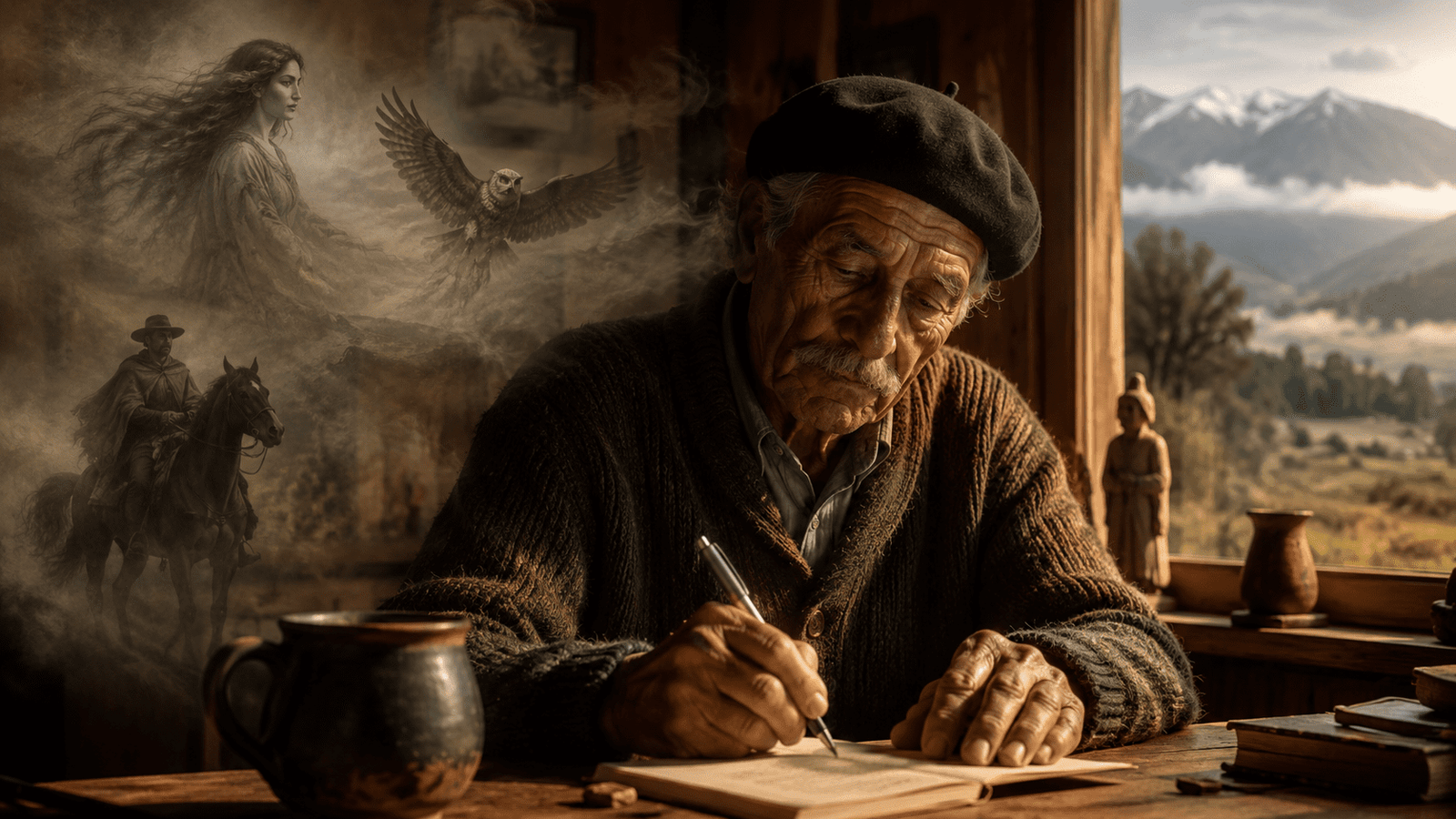
Chile opens a literary competition with a new category for senior citizens
The Regional Secretariat of Culture, Arts, and Heritage of the O'Higgins Region, together with SENAMA (National Service for the Elderly) and the Municipality of Rancagua, launched the 13th edition of the Óscar Castro Short Story Contest . This year's contest includes a significant new feature: a category for people aged 60 and over . Submissions will be accepted until June 30, 2026 , Chilean time.
Editorial reading: the new category for older adults transforms the contest into more than just a literary event. It becomes a form of cultural preservation: each story can hold a familiar voice, a rural legend, a childhood memory, or a recollection passed down before archives existed. In times of speed reading, writing 300 words can be a way to prevent a story from disappearing.
The competition is open to residents of the Libertador General Bernardo O'Higgins Region and includes three categories: Youth , for participants aged 14 to 17; Adult , for those aged 18 to 59; and Senior , for those aged 60 and over. The rules stipulate that each participant may only apply to one category.
You may be interested in: Claudia Sandoval wins Aguascalientes 2026: when the body becomes a family archive.
Chilean myths and legends as a central theme
The echo of shared words
The 2026 edition is inspired by the motto “The Year of Mythology in Chile, the Echo of Shared Words .” Therefore, the stories must address myths, legends, beliefs, characters, and memories passed down through generations, with a special connection to the landscapes and communities of the O'Higgins Region: valley, mountains, countryside, or coast.
Submissions must be original, written in Spanish, and between 100 and 300 words in length , excluding the title. They must also be submitted under a pseudonym and must not include images or personal information within the text, in order to protect the integrity of the evaluation process.
What stories are lost when the elders stop telling them
Literature is also born in the kitchen, the countryside, and family memory.
The most powerful aspect of this call for submissions lies not only in the competition itself, but also in the new category for older adults. In a country where many family histories still live on through oral tradition, opening a category for those over 60 acknowledges that literature is not born solely in workshops, universities, or publishing houses.
It is also born in the kitchen, in the countryside, in the memory of neighborhoods, in childhood stories, and in what grandparents heard before learning to write it.
The call for submissions is gaining momentum because it unites three elements of high cultural value: senior citizens, Chilean mythology, and short stories . In just 300 words, a story can capture an apparition in the Andes Mountains, a rural belief, a sea tale, a familiar voice, or a legend repeated for decades.
Óscar Castro and the literary roots of Rancagua
A competition named after a key author of O'Higgins
The competition is named after Óscar Castro , a writer born in Rancagua in 1910. Memoria Chilena, from the National Library of Chile, points out that his work encompassed poetry and narrative, with distinct stylistic registers but united by a deep sensitivity towards the landscape, the characters and the human experience.
That territorial connection matters. A regional contest that invites writers to explore myths and legends doesn't just aim to produce texts; it can also spark a conversation about local identity. O'Higgins emerges here as a narrative space where valley, mountains, countryside, coast, popular memory, and short stories coexist.
Orality, reading and writing within the same cultural policy
Oral memory as living literature
The new National Reading, Writing, and Orality Plan broadened its scope beyond reading and explicitly incorporated writing and orality as related social practices. According to the National Cultural Heritage Service, the plan is aimed at people of all ages, from early childhood to old age.
The national theme for 2026 also points in that direction: to highlight oral narratives, legends and worldviews of the Chilean mythological imaginary, from the north to the southern zone.
Therefore, this event can be interpreted as more than just a regional activity. It is a cultural sign: Chile is beginning to view orality not as a relic of the past, but as a living form of literary memory.
Quick tips for the Óscar Castro Competition 2026
- Contest: 13th Oscar Castro Short Story Contest.
- Region O'Higgins, Chile.
- New category: Senior citizen, from 60 years of age.
- Other categories: Youth, from 14 to 17 years old; Adult, from 18 to 59 years old.
- Topic 2026: myths, legends, oral tradition and memories passed down between generations.
- Extension: minimum 100 words and maximum 300, not including the title.
- Application deadline: until June 30, 2026, 23:59 hours, Chile continental time.
- Awards: between $200.000 and $550.000 Chilean pesos, depending on the category and location.
- Results: no later than October 28, 2026.
- Unconfirmed information: final list of the jury; the rules indicate that it will be published along with the results.
See: Rain also writes: when literature teaches us to wait.
What might happen next?
If the senior citizen category sees good participation, the contest could become a valuable tool for rescuing stories that rarely make it to print. The key will be whether cultural institutions can ensure that these stories don't remain merely as submissions, but rather become a readily available resource for new generations of readers.

I am Betty, author and curator of this space. I work with the method Read · Distill · CountI read classic and modern versions, distillate the heart of the story and it story using clear language, respecting the original meaning and proposing values workable.
I prioritize public domain when appropriate and I point out the adaptation When I make it. On each piece I indicate edad y reading timeand when it adds value PDF, audio y comprehension questionsI update content regularly; if I make significant changes, I mark them on the page. If you notice anything that could be improved, please let me know: my goal is for every reading experience to be enjoyable. accompany y teach with rigor and warmth.