
Chile adds 100 audiobooks: when literature also enters through the ear
The Digital Public Library incorporated nearly 100 new audiobooks to its collection, with works for children and adults.
The news raises a key question for today's reader: is reading still just looking at a page?
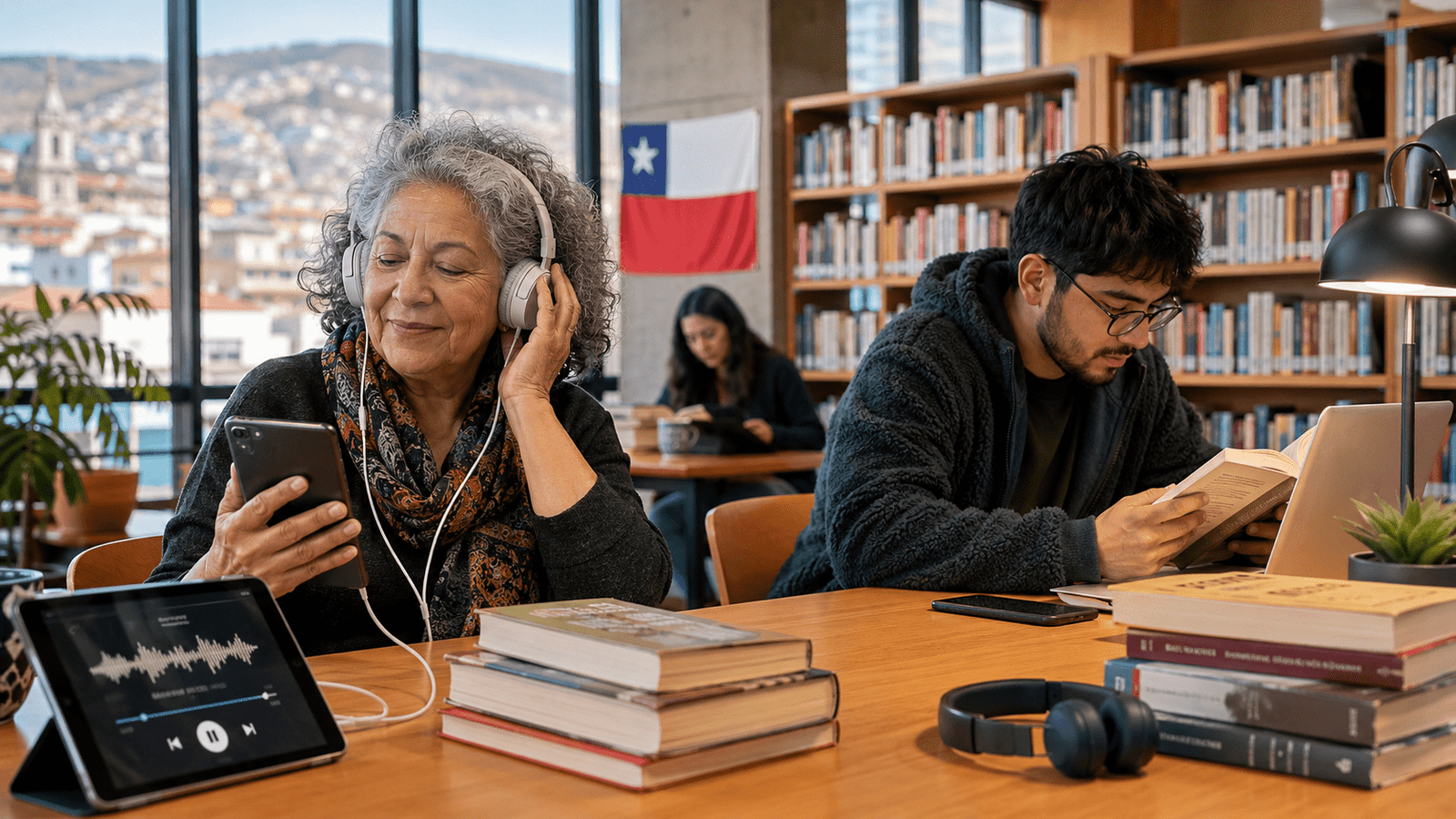
Chile expands its audiobook catalog in the Digital Public Library
The Ministry of Cultures, Arts and Heritage announced the addition of nearly 100 new audiobooks to the collection of the Digital Public Library , a program of the National System of Public Libraries of the National Cultural Heritage Service. The announcement was made on April 20, 2026 , at the Ñuñoa Literary Café, with the participation of Minister Francisco Undurraga and Mayor Sebastián Sichel.
The selection includes children's and adult literature, with works from Chilean and Latin American publishers such as Ediciones UC, Muñeca de Trapo, LOM, La Pollera Ediciones, Babel, Sexto Piso, and Laguna Libros . The acquisition is part of Book Month 2026 and aims to broaden the reach of national and Latin American publishers.
Reading can also be listening
The rise of audiobooks is changing a long-held idea: that reading only happens when the eyes scan a page. Today, a book can also accompany a person while they walk, travel, cook, rest, care for someone, or face visual difficulties.
Accessible reading as a cultural policy
Editorial perspective: the inclusion of audiobooks is not a technological detail; it is a way to expand the right to read. When a public library allows free audiobook listening, it acknowledges that not everyone reads in the same way, for the same amount of time, or under the same physical conditions. Literature ceases to depend solely on sight and opens itself to hearing, to oral memory, and to new access routines.
This point is especially important for older people, readers with visual difficulties, students, time-poor workers, and users who already engage with culture through mobile devices.
You may be interested in: Sergio Ramírez and Vargas Llosa's chair: the RAE looks towards the Latin American exile.
What books can be listened to in the new collection
Among the available titles mentioned by the Ministry are Porái , by José Miguel Varas; Salomé , by Elaine Vilar Madruga; Islas de calor , by Malú Furche; Tao Te King , by Gastón Soublette; La muerte viene estilando , by Andrés Montero; Y por mirarlo todo nada veía , by Margo Glantz; Mi mascota , by Yolanda Reyes; and El color de la piel , by Ramón Díaz Eterovic.
Chile and Latin America in Audible Format
The list showcases a broad range of offerings: narrative, children's literature, thought, Chilean authors, and Latin American voices. It's not simply about adding audio files to a platform, but about circulating works that can reach audiences beyond the typical reader of printed books.
The Digital Public Library had already announced in February 2026 a major update to its catalog with 1.000 new titles , including more than 100 Chilean and Latin American audiobooks for listening on mobile devices and computers. This update was presented as part of its commitment to democratizing access to culture and reading.
How to access the Digital Public Library
The Digital Public Library functions like a traditional library, but in digital format: it allows users to request titles and access content from various devices. The National System of Public Libraries explains that loans last for 14 days , renewable for another seven if a copy is available.
A library available from your cell phone
The Ministry indicated that to access the content from cell phones or tablets, the BPDigital application, available on the App Store, Google Play, and AppGallery, must be installed . It can also be read offline on a computer using Adobe Digital Editions, once the book has been downloaded from the BPDigital website.
During the announcement, a workshop was also held for reading groups and senior citizens in Ñuñoa. The session explained how to download the application, register, and request loans of digital books, audiobooks, audio stories, and multimodal content.
Why this news matters to Chile
Chile is not only adding titles: it is recognizing that reading habits have changed. Digital reading, audiobooks, and multimodal content are part of a larger conversation about access, time, inclusion, and new ways of engaging with literature.
From the book as object to the book as experience
The printed book remains central, but it is no longer the only path. Listening to literature can also be an aesthetic, intimate, and educational experience. In a country where public libraries fulfill a cultural and social function, expanding the audio catalog makes reading accessible to people who might not otherwise reach them through traditional means.
The fundamental question isn't whether audiobooks replace books. The more interesting question is: how many new readers might emerge when we stop demanding only one way to read?
See: Casa de América seeks new American poetry: unpublished voices to break the publishing map.
Quick keys
- Done: incorporation of nearly 100 new audiobooks to the Digital Public Library.
- Ad: 20 April 2026.
- Location: Literary Café of Ñuñoa, Chile.
- Institution: Ministry of Cultures, Arts and Heritage.
- Program: Digital Public Library of the National System of Public Libraries.
- Public: children's and adult literature.
- Featured stamps: UC Editions, Trapo Doll, LOM, La Pollera Editions, Babel, Sexto Piso and Laguna Books.
- Angle World Writers: Reading can also be listening.
What might happen next?
The rise in audiobooks can open a broader conversation about accessible reading in Chile. Libraries, schools, book clubs, and community spaces could use these titles to bring literature to older adults, readers with visual impairments, and users who prefer to listen to books on their phones. If the Digital Public Library continues to expand its audio catalog, public reading in Chile could become more inclusive, mobile, and commonplace.

Jude Jacques is a poet, writer, and playwright with a strong background in business management. He teaches electricity at the Don Bosco Salesian Technical School, where he has over 15 years of experience training future electrical professionals. His work combines the humanistic perspective of the arts with the rigor of technical education, bringing a unique perspective both in the classroom and in his creative projects.