
Rhyme in poetry: assonance vs. consonance with examples
Rhyme is a tool for consolidating memory, creating a musical effect, and crafting a strong ending. It's not just decoration: when you choose how a verse rhymes, you also choose how it will be remembered . Here we'll start with the essentials and leave the guided practice for Part 2.
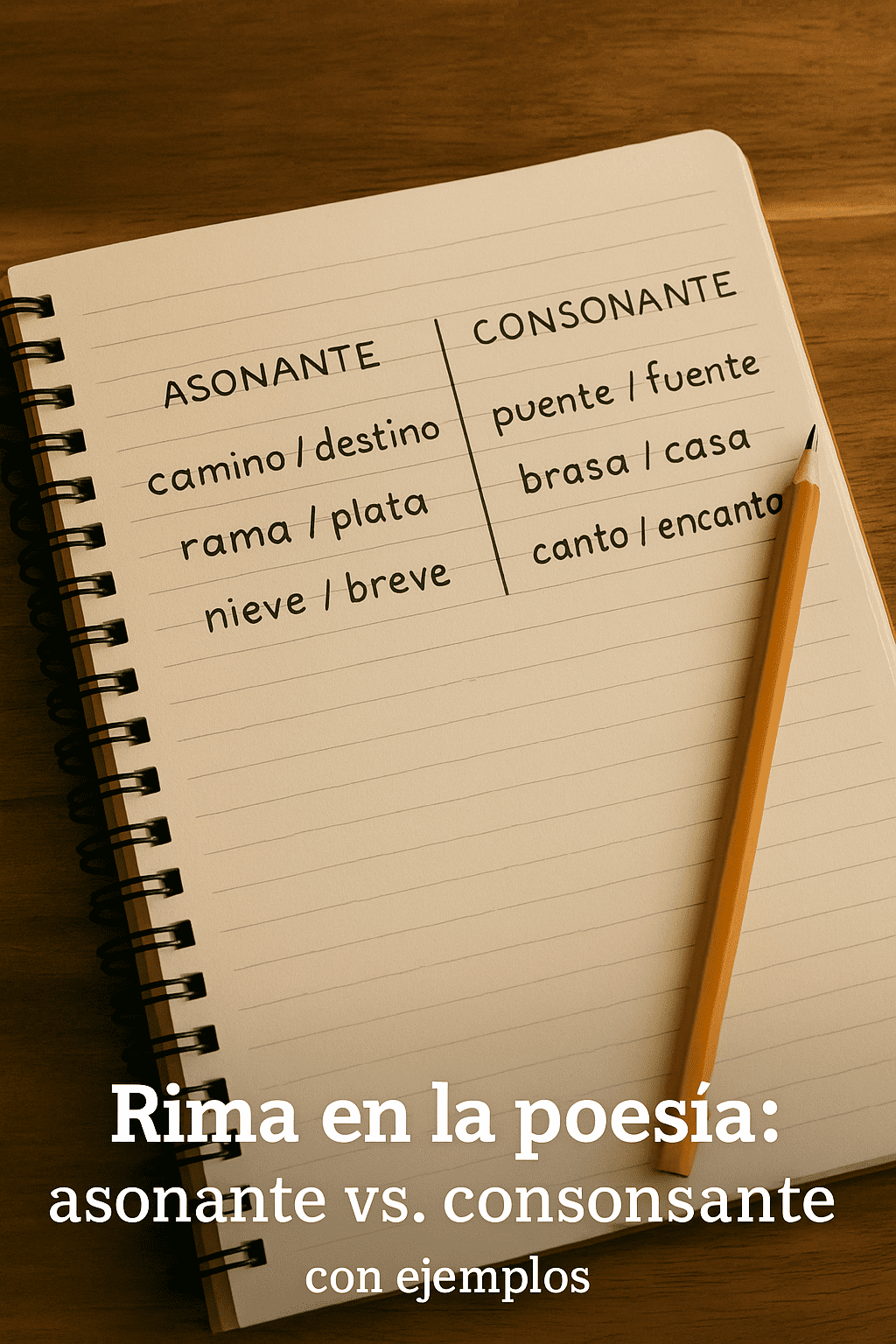
What is rhyme in poetry (and what is it for)
Rhyme as memory, music, and closure
- Memory: It makes it easier for the ear to anticipate the end and retain the verse.
- Music: It creates waves; depending on the type of rhyme, it will sound more fluid or more overwhelming.
- Closing: a well-placed rhyme gives auction, as if the idea were carved into the ground.
How to count: stressed vowel and rhymed section
To find out if two verses rhyme, look at the stressed vowel of their last word (the accented syllable) and compare from there to the end :
- If they match only the vowelsit's assonant.
- If they match vowels and consonantsit's consonant.
If you want to review syllable counting, the law of the final accent (acute/grave/proparoxytone) and the relationship with the ear, here is a clear guide: Metrics in Spanish: minor art and major art.
Difference between assonant and consonant rhyme (clear explanation)
Assonance: the vowels coincide (from the stressed syllable)
- Key idea: They maintain the “color” of the vowelsbut they allow freedom in consonants.
- Typical effect: fluency and naturalness; ideal for narrative and conversational tone.
Short (original) examples:
- Assonant “ío”
“The tram sings in the middle of the path.
The street crosses and names my desTino. " - Assonance “aa”
“The moon rests its shoulder on the home.
The afternoon bends the light over the branch. "
Note that the coincidence is the vowel pattern from the tonic: í-o / í-o ; aa / aa.
Consonant: vowels and consonants coincide (from the stressed syllable)
- Key idea: requires coincidence full of sounds; it is more precise and forceful.
- Typical effect: auction and a sense of closure, very useful for formal endings and stanzas.
Short (original) examples:
- Consonant “-ente/-ente”
“The river remains calm beneath the bridge,
and the people learn their rumor of source. " - Consonant “-asa/-asa”
“I light the fire, the ember,
and the bread breathes its warmth home. "
Quick comparison table
| Rhyme type | What matches? | Effect on reading | Example couple |
|---|---|---|---|
| Assonant | Only vowels from the tonic | Fluency, naturalness | camí-no / destí-no · chandle / rá-ma |
| Consonant | Vowels and consonants from the tonic | Precision, finishing | puentity / fuentity · chandle /brhandle |
To continue (useful link, 1 time each)
- If you're interested in what a closure sounds like formal and forcefulLook at how a paradigmatic fixed form works: The charm of the sonnet: an ode to the beauty of poetry.
- If you prefer freedom without losing music, here's how it works build the rhythm without mandatory rhyme: Exploring the depths of free verse.
Assonant rhyme: uses, effects and examples
When is it appropriate (fluency, narrative, conversational tone)
- Narrative fluency. The coincidence of vowels alone creates a gentle swell that doesn't "squeeze" each closure.
- Dialogue or friendly tone. It sounds more spokenIt works very well in everyday scenes.
- Long poems. It is less tiring than the consonant when there are many stanzas.
Examples in octosyllabic verse (couplets and quatrains)
- Couplet (assonant “-ío”)
The train tilts towards the river,
best memory of a cold. - Couplet (assonance “aa”)
The table holds the cup,
the shadow grows in the DINING. - Quatrain (assonant “ee” in pairs)
*I cross the street indesis,
*I ask under the snow;
*Your name remains in the front,
close the door and me Rains.
Common Mistakes (and How to Avoid Them)
- “Ghost rhyme”. Forcing dubious assonances (coffee / bad). → Check the stressed vowel and listen aloud.
- Monotony. Everything remains the same for many verses. → Introduce overlaps or varies length of the verse.
- Confusion with a consonant. Believing that sound similarity constitutes a complete rhyme. → Check the final consonants.
Consonant rhyme: uses, effects and examples
When is it appropriate (precision, closure, solemnity)
- A powerful ending. Perfect for putting the finishing touches on ideas or thesis of the poem.
- Fixed forms. It conforms to molds that demand symmetry (quatrains, serventesios, sonnets).
- High pitch. It adds a shine classic if the topic calls for it.
Examples in hendecasyllables (couplets and serventesio)
- Couplet (-entity/-entity)
The gentle river returns beneath the bridge,
and time drinks in its murmur of source. - Serventesian (ABAB, -or/-a/-or/-a)
He gets up early burning with light that does not turns off,
I breathe in the sun at the window that dora;
The new day dawns with force,
and the cup trembles on the tablecloth clara.
Consonant cleaning (final consonants, diphthongs, spellings)
- Final consonants. property does not rhyme with hunting (sound /s/ vs /θ/ depending on the region). ListeningDon't just read.
- Diphthongs/hiatuses. song does not rhyme with reason (ion ≠ on).
- Different spellings, same sound. Leaf / red → Yes, they rhyme (consonant). The important thing is not the spelling.
What alters or conditions the rhyme (without confusion)
Synalepha, syneresis and diaeresis
- sinalefa (between words): the other → joins vowels and softens the closure.
- syneresis (within word): poet → poet → can bring rhymes closer.
- umlaut (opposite): noise → ru-i-do → Open the compass; use it if the rhythm He asks for it.
Practical rule: first decide the rhythmic effect and only then does he adjust the rhyme.
Law of the final accent (acute/grave/proparoxytone)
- Sharp: +1; Full: 0; Proparoxytone: −1. It affects the count and fall of the rhyming word.
Tip: place words powerful in the finals Plains if you're looking for naturalness.
Enjambment and verse break
- overridingThe meaning continues and the rhyme it doesn't become predictable.
- CuttingIf you leave a keyword at the beginning of the next verse, the final rhyme resonates more.
Choose rhyme according to intention and form
Narrating vs. closing
- Narrate/scene → Assonant (flows, sustains without “squeezing”).
- Closing/thesis → Consonant (closes and fixes).
Romance (assonant in pairs) vs. Sonnet (consonant)
- Romance: octosyllabic words with assonance in pairs → direct current, ideal for story.
- Sonnet: hendecasyllables with a consonant → planning–development–turn–closure polished.
What if I don't want to rhyme?
You can work with music using repetition, parallelism, breaks , and silence in free verse . The important thing is that there is a rhythmic principle.
Practical workshop (10–15 minutes)
- Warm the ear (5 min).
Write 6 pairs of words and classify them:- Assonant: path/destination; house/branch; snow/always.
- Consonant: bridge/fountain; ember/house; song/charm.
Read aloud and mark the stressed vowel.
- Rewriting with a purpose (5 min).
Take these assonant couplets and convert the second line to consonant maintaining the meaning:- “He crossed the street with a stride slow / left his letter under the port. "
- “Your laughter remains etched in me fourth / the afternoon turns searching for its protection. "
(Free solution: adjust final words until achieved) full agreement.)
- Quatrain with echo (5 min).
Write one quatrain: 1–2 (setup) / 3 (turn) / 4 (close).- Verses 1–2: assonance.
- Verses 3–4: consonant for closure.
Read it aloud: the end Weighs plus?
Mini applied glossary
- Assonance: Equality of vowels from the tonic.
- Consonance: Equality of vowels and consonants from the tonic.
- Rhyme impurity: almost the same coincidence as dirty The effect.
- rhyme scheme: closure pattern (ABBA, ABAB, —a—a…).
- internal rhyme: coincidence within the verse (useful for creating waves).
FAQ
Can I mix assonance and consonance in the same poem?
Yes, there is one. criterion (for example, narrative stanzas in assonance and a final closing in consonance).
Why does my consonant rhyme "not sound" the same if the words are spelled similarly?
Because he rules. not the spelling. Check the pronunciation real.
Is poor rhyme (moon/fortune) always a mistake?
Not necessarily, but it sounds repeated foreseeable. Proof semantic fields different to surprise.
In free verse, is it advisable to avoid all rhyme?
No: even in free verse, a occasional rhyme can create eco and cohesion.
Conclusion: rhyme in service of the image
Deciding between assonance and consonance is not a matter of etiquette: it defines how the poem breathes . The former flows and narrates, the latter closes and fixes. Choose according to your intention and the form that will sustain the idea.

I am Stevenson Jacques, originally from Haiti, a professional electrician , theater actor, novelist, poet, writer, art lover, known as "Steve the Poet".
In 2008 I began to work more in the world of art, writing and theater; I was part of several theater companies.
Since 2014 I have been a member of “Tanbou Literè”; a group of dynamic young people who love art and literature.
I published in the anthology "Champurria" in 2018, and in the literary magazine "Desvanecimiento" in 2022. I have participated in several writing workshops and literary courses.
I am a member of a very dynamic and committed group of Haitian writers of my generation, “REK”; They are activist writers in defense and appreciation of the Haitian Kreyòl language.
After many years of publishing sporadically, I decided to publish my first bilingual poetry collection, "flor de tumba – Flè kav," along with its accompanying audiobook, in January 2023. In the same year, 2023, I published a novel in Creole, "Depi nan benbo," which I had been working on for over six years.