
Visual and experimental poetry: when words are also images
Visual and experimental poetry questions how we say things, not just what we say. It plays with page layout, typography, white space, images that emerge from the letters, and media that extend beyond paper (screen, audio, body). For me, it was a liberating discovery: understanding that a verse can also be drawn , moved, or sounded changes the way I read and write.
What is visual and experimental poetry?
It is a family of poetic practices that explore the visual and material dimension of language: calligrams, object-poems, typography that “performs,” pages that are read in a spiral, pieces that combine text, image, and sound. The idea is not to “decorate” the poem, but rather for the form to be meaning : the page design, the font size, or the reading path all contribute to the meaning.
If you want a larger map to locate it among other forms, this panoramic view will be useful: here you can place it within the set of verse families in Types and Forms of Poetry.
Essential features (and why they resonate with young readers)
1) The form says
It's not just decoration: the visual journey builds meaning. A spiral poem can suggest vertigo; a descending text, falling or rain.
2) Active reading
The reader participate!Rotate the page, follow arrows, choose routes. Ideal for workshops and classrooms, where poetry becomes serious play.
3) Crossing of languages
Text + image + typography + (sometimes) audio or video. A poem can begin on paper and continue on a screen.
4) Minimalism with impact
A single word in the center—or a huge silence—can mean more than twenty lines.
If you want an easy first game that combines shape and letter, this classic and effective resource will do the trick: here's a friendly guide to creating pieces with their own names in discovering the charm of acrostics.
Common modalities (with usage ideas)
Calligram (poem-drawing)
The text draws what it talks about (a fish, a leaf, the moon).
- Use: Start workshops; ideal for elementary school students and also for the general public who "don't dare" to try poetry.
- Tip: Start with simple silhouettes; less is more.
Typographic poem
Typography (size, weight, font family) builds emotion. A word can shout in bold or whisper in small.
- Use: one-word poems + poetic subtitles; posters.
Poem-object / collage
The poem incorporates materials (tickets, photos, clippings).
- Use: memory, personal chronicle, poetic family album.
- Tip: Pay attention to legibility; the object should not "smother" the verse.
Instructional poem (reading paths)
Arrows, numbers, paths that guide the reader through the text.
- Use: humor, surprise, interactive pieces for social media.
Performative poem (body and space)
The arrangement becomes action: the poem is read by moving; the words are on the floor or on the wall.
- Use: exhibitions, classroom, recitals, slam.
If you're interested in those spaces of voice and body, you'll love this bridge to the stage: an introduction to the living word in urban poetry and slam .
Why does it work today?
Because it is intuitive, visual and shareableIt resonates well with the culture of images and social media; it opens doors to readers who might not enter through a sonnet, but would through a piece that it looks y it feels immediately.
If you want to see how it interacts with current styles and trends (orality, screen, hybrid formats), this map provides context and examples: an overview of the present in contemporary poetry .
Recommendations for writing (without losing the meaning)
- Start with the ideaNot because of the effect. Question: What emotion or thought will sustain the piece if I remove the design?
- Choose a stand (paper, screen, object) and a formal principle (silhouette, typography, route).
- Design a route Clear reading: where does the eye begin? Where does the visual accent fall?
- Pay attention to the contrast.The visual aspect should accompany the word, don't cover it up.
- Reading testAsk someone who didn't see the process to read/watch it. If they understand the process without explanation, you're close.
If you then want to turn the idea into a free verse piece without fixed meter or rhyme, it will be good to train your pulse: here is a practical and accessible guide to free verse.
A micro-example (described)
"Rain" :
- The word rain It appears 7 times in a vertical line, each time smaller, as if it were falling.
- At the bottom, a cup with the word café in capital letters.
- Suggested reading: the rain “falls” on the coffee.
Sense: the gentle wait of an afternoon at home.
This type of simple design works very well in workshops and networks.
Crosses that inspire you
- If you want to combine visuals with wordplay, acrostics are a direct and rewarding way to do it: See ideas and examples in Discovering the charm of acrostics .
- If you prefer to release short, powerful pieces to share, rhythmic patterns and short exercises will help: Here's a friendly routine in poetry exercises .
Practical templates (ready to adapt)
Use these structures as scaffolding . First, test the mold as is; then remove pieces until it breathes with your voice.
1) Basic calligram (poem-drawing)
ideas: Write on “leaf” forming the silhouette of a leaf.
Steps:
- Draw the outline gently in pencil.
- Write short verses following the contour (outside → inside).
- Erase the pencil lines when you're finished.
Suggested text (editable):
“leaves falling / like open letters / // the street learns / to read in green / // and I fold October / at four corners.”
If you want more games with letters and proper names (ideal for starting with groups), this friendly guide to acrostics will help you : check out discovering the charm of acrostics ,
2) Typographic poem (volume and whisper)
ideas: A piece about “shouting / being silent” using sizes y thickness.
Rule: Words that “increase” in size when the self loses its composure; they decrease to fine lowercase when it regains its center.
Structure (text + style):
- SHOUT (H1 bold)
- “I ran out of breath” (body light)
- GRI (H2 bold)
- “breathe” (caption light)
- GR (H3 semibold)
- “I hear you” (body)
- g (small caps)
- “I’m back” (body regular)
3) Poem-object (memory collage)
ideas: “Travel suitcase”.
Makings: old ticket, mini map, photo, coffee receipt.
Edition: Glue an envelope to the page. Inside, each object with A line written on the back (e.g., “here I learned your name in another language”). The reader pulls out y lee.
If you are going to share this type of piece with readers or in class, it is advisable to add short routines to generate textual material: here is a guide with mini-challenges in poetry exercises.
4) Reading route (instructional poem)
ideas: “Map of the night”.
Design: Numbered arrows (1→2→3).
Base text:
- “Turn off the lamp / Let the walls speak”
- “walk silently / the kitchen smells of memories”
- “come back / the house has already spoken your name”
5) Performative poem (body and space)
ideas: "Bridge".
Staging: Two groups of readers on opposite sides; each group recites a verse alternating; in the end, they cross and they change places.
Guide verses: “to stay / to go / to stay / to go… / to return”.
If you're interested in live spoken word formats in stages and recitals, this short introduction will be useful: take a look at urban poetry and slam.
8 workshop ideas (classroom, book club or networks)
- Shadow calligram (20 min)
Project the shadow of an object (a plant, a cup) and writes its “biography” in verses inside. - Talking Cup (15 min)
Paste the silhouette of a cup. Inside, only verbs in gentle imperative (“calm, wait, smoke”). Minimalist and powerful. - One-word poster (15 min)
Choose a key word (“home”, “courage”, “shore”). Design a typographic poster with 1 large word and 3 small lines that rotate around it. - Unarmed Letter (25 min)
Write a short letter and cut it off in 5 strips. Rearrange them to create a visual poem. Play with surprise. - Arrow path (15 min)
On a sheet of paper, draw a route with arrowsAt each station, an image. The reader "walks" and reads. - Pocket map (20 min)
Draw a pair of pants with pockets and write inside. what do you keep Today (button, song, bravery). Optional collage. - Expanded Haiku (15 min)
Write a haiku and arrange its words separately in space, as if they were fireflies. - Loop for networks (10 min + editing)
Create a 3-line micro-poem. Design a base image and export it as a carousel (line 1 → line 2 → line 3). Publish with a subtle CTA: “Which line resonated with you?”
To learn about rhythmic patterns that are well-suited to the short visual format, this journey through free verse will be useful : here is a guide to time signatures and breaks in free verse : and a development with practical examples in Exploring the Depths of Free Verse.
Original example ready for layout (description + text)
Title: “Traffic Light” (typographic-visual poem)
Visual concept: Three vertical circles (red, yellow, green) like a traffic light; each light contains a micro-poem.
Layout:
- RED (top circle, red background, white text in small capitals):
“Stop / there are heartbeats / on the corner.” - YELLOW (center circle, amber background, regular black text):
“breathe / listen / to the whisper of your name.” - GREEN (bottom circle, green background, bold white text):
“Move forward / the city / has learned you.”
Meaning: an emotional journey. The color says (stop / wait / continue) while the text reinterprets it.
Useful crossroads (for further exploration)
- If you're looking for ready-to-play pieces with initials and names (ideal for workshops and social media), you'll love this direct link: ideas and examples in acrostics .
- If you want to enrich your practice with short exercises that you can then visualizeHere's a phased routine: mini-challenges in poetry exercises .
- To connect with what is being read and shared today (hybrid forms, orality, screen), this map will be useful: trends and examples in contemporary poetry.
Frequently Asked Questions (FAQs)
Does visual poetry “need” long text?
No. Often less is moreOne big word, two small lines, and a visual pause can say it all.
What if I can't draw?
It's not necessary. Work with simple silhouettes, typography y collageThe key is that the form contribution meaning.
Is it possible to bring it into the classroom without expensive materials?
Yes. Paper, pencil, scissors, glue, and magazine clippings are all you need. The goal is think of form as part of the poem.
Is this poetry or design?
It is poetry because the the language (word, disposition, silence) constructs meaningDesign serves meaning.
How do I share it on social media without losing readability?
Usa clean fundsHigh contrast and horizontal or square format. Test your design on mobile before publishing.
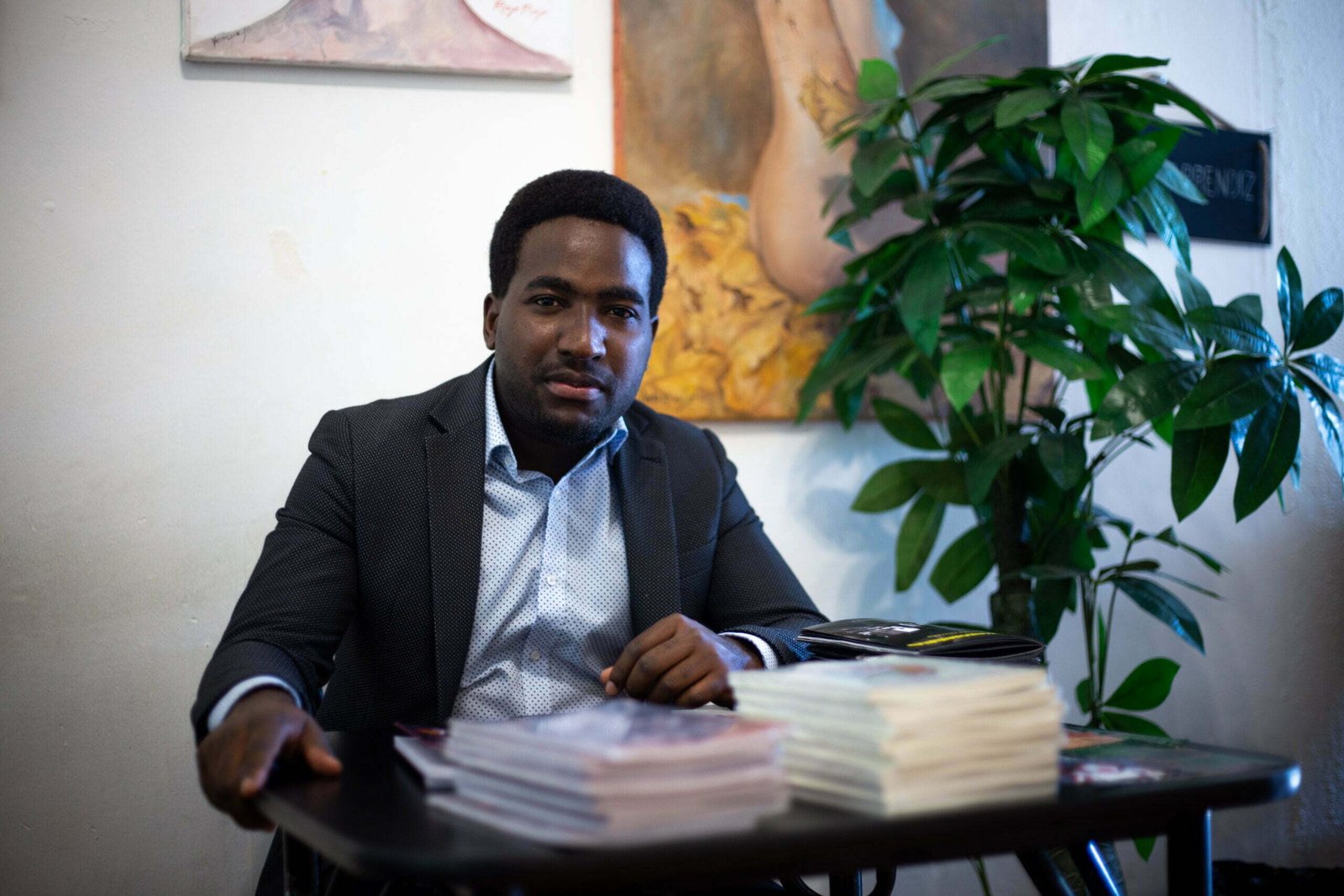
I am Stevenson Jacques, originally from Haiti, a professional electrician , theater actor, novelist, poet, writer, art lover, known as "Steve the Poet".
In 2008 I began to work more in the world of art, writing and theater; I was part of several theater companies.
Since 2014 I have been a member of “Tanbou Literè”; a group of dynamic young people who love art and literature.
I published in the anthology "Champurria" in 2018, and in the literary magazine "Desvanecimiento" in 2022. I have participated in several writing workshops and literary courses.
I am a member of a very dynamic and committed group of Haitian writers of my generation, “REK”; They are activist writers in defense and appreciation of the Haitian Kreyòl language.
After many years of publishing sporadically, I decided to publish my first bilingual poetry collection, "flor de tumba – Flè kav," along with its accompanying audiobook, in January 2023. In the same year, 2023, I published a novel in Creole, "Depi nan benbo," which I had been working on for over six years.