
Historias cortas en inglés con traducción al español
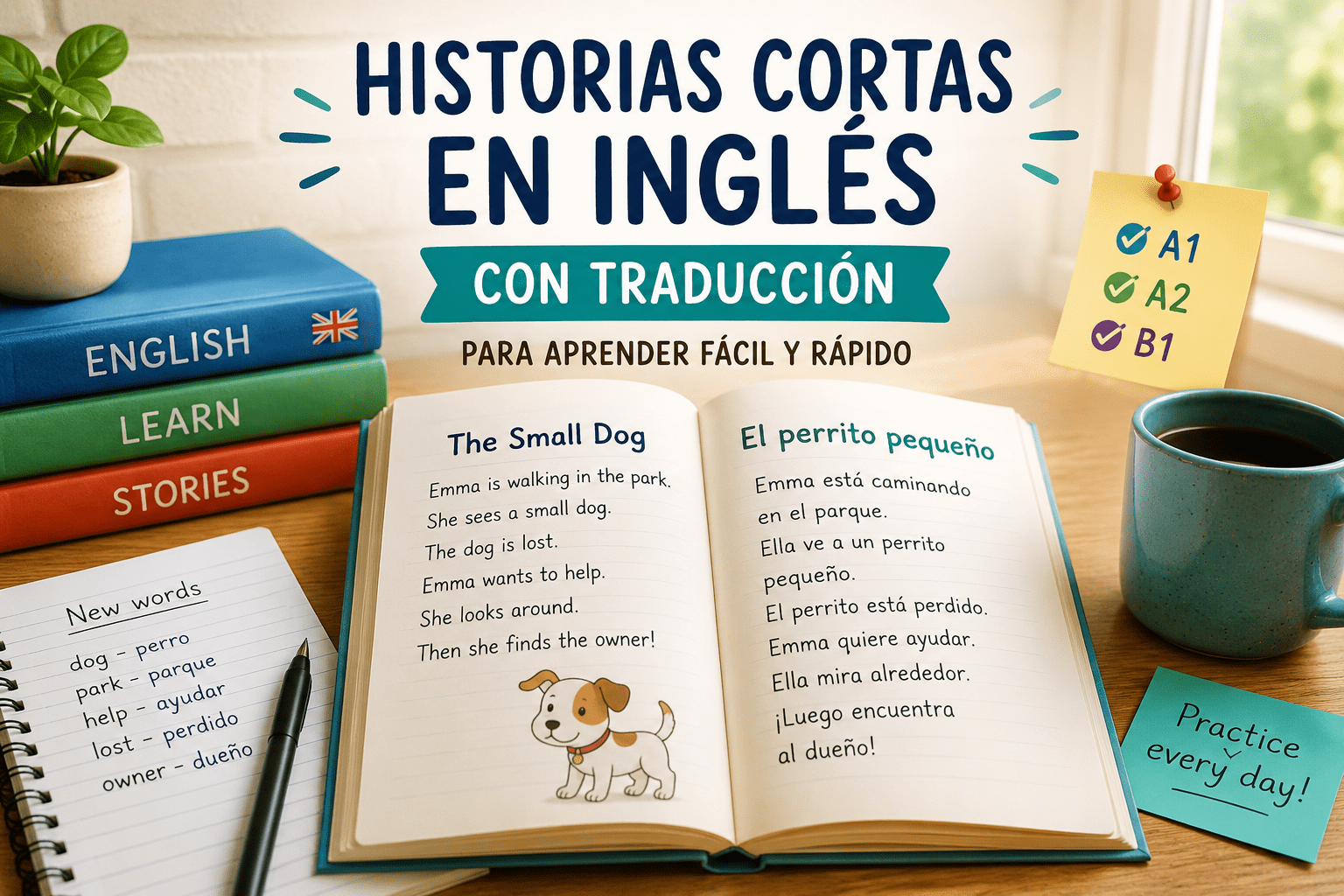
Aquí encontrarás historias cortas en inglés con traducción al español, organizadas por nivel: A1, A2 y B1. Cada historia incluye texto en inglés, traducción, vocabulario clave, una frase útil y preguntas de comprensión para practicar sin complicarte.
Historias cortas en inglés: qué encontrarás aquí
Esta selección está pensada para leer en inglés sin perderte. Primero verás la historia, luego su traducción al español y después una pequeña ayuda para aprender mejor el vocabulario.
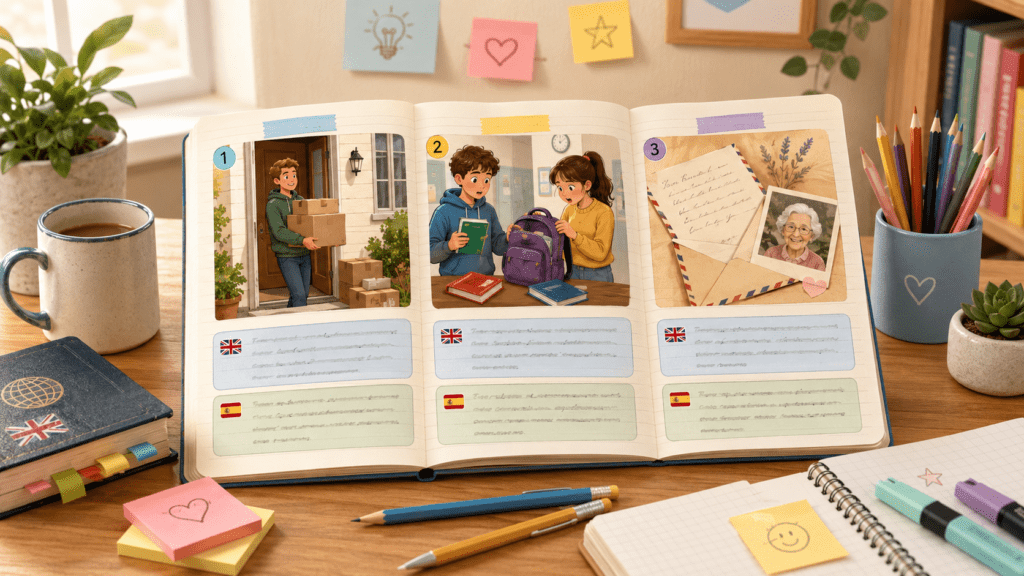
Historias cortas en inglés nivel A1 con traducción al español
1. The Lost Key / La llave perdida
Story in English
Anna wakes up early. It is Monday, and she has English class at school.
She eats breakfast with her mother and her little brother, Leo. Then she puts her books in her bag.
“I am ready,” Anna says.
She walks to the door, but then she stops.
“My key,” she says. “Where is my key?”
Anna looks on the table. There is a book, a pencil and a cup, but there is no key.
She looks in her school bag. She finds her notebook, her lunch and her blue pen, but not the key.
She looks under the chair. She looks near the window. She looks in the kitchen.
“I am late,” Anna says.
Leo looks at her and smiles.
“What are you looking for?” he asks.
“My key,” Anna says. “I can’t go to school without it.”
Leo points to the door.
“Look there.”
Anna looks at the door. The key is in the lock.
Anna opens her eyes and then laughs.
“Oh no! The key was here all the time.”
Her mother smiles.
“Sometimes we look far away for things that are very near.”
Anna takes the key, closes the door and runs to school.
She is not late.
Traducción al español
Anna se despierta temprano. Es lunes y tiene clase de inglés en la escuela.
Desayuna con su madre y su hermano pequeño, Leo. Luego pone sus libros en la mochila.
—Estoy lista —dice Anna.
Camina hacia la puerta, pero se detiene.
—Mi llave —dice—. ¿Dónde está mi llave?
Anna mira sobre la mesa. Hay un libro, un lápiz y una taza, pero no está la llave.
Mira en su mochila escolar. Encuentra su cuaderno, su almuerzo y su bolígrafo azul, pero no la llave.
Mira debajo de la silla. Mira cerca de la ventana. Mira en la cocina.
—Voy tarde —dice Anna.
Leo la mira y sonríe.
—¿Qué estás buscando? —pregunta.
—Mi llave —dice Anna—. No puedo ir a la escuela sin ella.
Leo señala la puerta.
—Mira allí.
Anna mira la puerta. La llave está en la cerradura.
Anna abre los ojos y luego se ríe.
—¡Ay no! La llave estaba aquí todo el tiempo.
Su madre sonríe.
—A veces buscamos lejos cosas que están muy cerca.
Anna toma la llave, cierra la puerta y corre a la escuela.
No llega tarde.
Vocabulario clave
| English | Español |
|---|---|
| key | llave |
| door | puerta |
| school | escuela |
| bag | mochila / bolso |
| table | mesa |
| chair | silla |
| window | ventana |
| kitchen | cocina |
| late | tarde |
| look for | buscar |
Frase útil
I can’t go to school without it.
No puedo ir a la escuela sin eso.
Preguntas de comprensión
- What day is it?
- What is Anna looking for?
- Where is the key?
- Who helps Anna?
2. A Rainy Morning / Una mañana lluviosa
Story in English
It is Tuesday morning. Tom wakes up and hears the rain.
He goes to the window. The sky is gray. The street is wet. People walk with umbrellas.
“Oh no,” Tom says. “I don’t like rain.”
His mother comes into the room.
“Good morning, Tom. It is time for school.”
Tom looks at his shoes.
“But it is raining,” he says.
His mother gives him a yellow umbrella.
“Take this umbrella. You can walk to school.”
Tom takes the umbrella and goes outside. The rain is soft, but the air is cold.
On the way to school, Tom sees a small cat under a tree. The cat is wet and sad.
Tom stops.
“Hello, little cat,” he says.
The cat looks at him but does not move.
Tom opens his umbrella and holds it over the cat. Now the cat is dry.
A girl from his class walks by.
“That is very kind,” she says.
Tom smiles.
The girl says, “I know that cat. It lives near my house.”
Together, they help the cat go home.
When Tom arrives at school, his shoes are wet, but he is happy.
Maybe rainy mornings can have good moments too.
Traducción al español
Es martes por la mañana. Tom se despierta y escucha la lluvia.
Va a la ventana. El cielo está gris. La calle está mojada. La gente camina con paraguas.
—Ay no —dice Tom—. No me gusta la lluvia.
Su madre entra en la habitación.
—Buenos días, Tom. Es hora de ir a la escuela.
Tom mira sus zapatos.
—Pero está lloviendo —dice.
Su madre le da un paraguas amarillo.
—Lleva este paraguas. Puedes caminar a la escuela.
Tom toma el paraguas y sale. La lluvia es suave, pero el aire está frío.
De camino a la escuela, Tom ve un gato pequeño debajo de un árbol. El gato está mojado y triste.
Tom se detiene.
—Hola, gatito —dice.
El gato lo mira, pero no se mueve.
Tom abre su paraguas y lo sostiene sobre el gato. Ahora el gato está seco.
Una niña de su clase pasa caminando.
—Eso es muy amable —dice.
Tom sonríe.
La niña dice:
—Conozco a ese gato. Vive cerca de mi casa.
Juntos, ayudan al gato a volver a casa.
Cuando Tom llega a la escuela, sus zapatos están mojados, pero él está feliz.
Quizá las mañanas lluviosas también pueden tener buenos momentos.
Vocabulario clave
| English | Español |
|---|---|
| rain | lluvia |
| morning | mañana |
| window | ventana |
| umbrella | paraguas |
| street | calle |
| wet | mojado |
| cat | gato |
| tree | árbol |
| kind | amable |
| school | escuela |
Frase útil
That is very kind.
Eso es muy amable.
Preguntas de comprensión
- What is the weather like?
- What color is Tom’s umbrella?
- What animal does Tom see?
- How does Tom help the cat?
3. The Small Dog / El perro pequeño
Story in English
Emma goes to the park with her father every Saturday.
She likes the park because there are trees, flowers and many birds. Her father sits on a bench, and Emma walks near the path.
One Saturday, Emma sees a small dog near a tree.
The dog is white and brown. It has big eyes and a red collar. It looks tired.
“Dad,” Emma says. “Look at that dog.”
Her father looks at the dog.
“Maybe its owner is near,” he says.
Emma waits. She looks around the park. There are children, bicycles and families, but no one calls the dog.
The dog comes slowly to Emma. It moves its tail, but it looks sad.
“Hello,” Emma says. “Are you lost?”
The dog sits next to her.
Emma looks at the red collar. There is a name: Max. There is also a phone number.
“Dad, Max has a number,” Emma says.
Her father takes his phone and calls.
A woman answers quickly.
“Max? Do you have Max?” she asks.
“Yes,” Emma’s father says. “He is in the park.”
Ten minutes later, the woman arrives. Max runs to her.
“Thank you,” the woman says. “Max is my son’s dog. He is very special to us.”
Emma smiles.
On the way home, her father says:
“You did a good thing today.”
Emma looks back at Max and feels proud.
A small action can make someone very happy.
Traducción al español
Emma va al parque con su padre todos los sábados.
Le gusta el parque porque hay árboles, flores y muchos pájaros. Su padre se sienta en un banco y Emma camina cerca del sendero.
Un sábado, Emma ve un perro pequeño cerca de un árbol.
El perro es blanco y marrón. Tiene ojos grandes y un collar rojo. Parece cansado.
—Papá —dice Emma—. Mira ese perro.
Su padre mira al perro.
—Quizá su dueño está cerca —dice.
Emma espera. Mira alrededor del parque. Hay niños, bicicletas y familias, pero nadie llama al perro.
El perro se acerca lentamente a Emma. Mueve la cola, pero parece triste.
—Hola —dice Emma—. ¿Estás perdido?
El perro se sienta junto a ella.
Emma mira el collar rojo. Hay un nombre: Max. También hay un número de teléfono.
—Papá, Max tiene un número —dice Emma.
Su padre toma el teléfono y llama.
Una mujer responde rápidamente.
—¿Max? ¿Tienen a Max? —pregunta.
—Sí —dice el padre de Emma—. Está en el parque.
Diez minutos después, la mujer llega. Max corre hacia ella.
—Gracias —dice la mujer—. Max es el perro de mi hijo. Es muy especial para nosotros.
Emma sonríe.
De camino a casa, su padre dice:
—Hoy hiciste algo bueno.
Emma mira hacia atrás a Max y se siente orgullosa.
Una acción pequeña puede hacer muy feliz a alguien.
Vocabulario clave
| English | Español |
|---|---|
| dog | perro |
| park | parque |
| father | padre |
| tree | árbol |
| bench | banco |
| owner | dueño |
| collar | collar |
| phone number | número de teléfono |
| lost | perdido |
| proud | orgulloso/a |
Frase útil
Are you lost?
¿Estás perdido?
Preguntas de comprensión
- Where does Emma go every Saturday?
- What is the dog’s name?
- What color is the collar?
- Who comes to the park at the end?
Historias cortas en inglés nivel A2 con traducción al español
4. The New Neighbor / El nuevo vecino
Story in English
Daniel lives in a quiet street with his mother and sister. Every afternoon, he rides his bike after school.
One Friday, he sees a moving truck in front of the empty house next door. A man is carrying boxes. A woman is cleaning the window. A boy about Daniel’s age is standing near the gate.
The boy has short black hair and a green backpack. He looks around, but he does not speak to anyone.
Daniel wants to say hello, but he feels shy.
The next morning, Daniel sees the boy again. This time, the boy is trying to carry a big box. The box is heavy, and some books fall on the ground.
Daniel runs to help.
“Hi, I’m Daniel,” he says. “Do you need help?”
The boy smiles.
“Yes, please. I’m Lucas.”
Together, they pick up the books and carry the box into the house.
Lucas shows Daniel his room. There are books, a soccer ball and a small guitar.
“You play guitar?” Daniel asks.
“A little,” Lucas says. “And you?”
“I play soccer,” Daniel answers.
Lucas smiles.
“I like soccer too.”
That afternoon, they go to the park with a ball. At first, they do not talk much. Then Daniel kicks the ball badly, and both boys laugh.
When Daniel goes home, his mother asks:
“Did you meet the new neighbor?”
Daniel smiles.
“Yes. I think I made a new friend.”
Traducción al español
Daniel vive en una calle tranquila con su madre y su hermana. Todas las tardes monta en bicicleta después de la escuela.
Un viernes, ve un camión de mudanza frente a la casa vacía de al lado. Un hombre está cargando cajas. Una mujer está limpiando la ventana. Un niño de la edad de Daniel está de pie cerca de la reja.
El niño tiene el pelo corto y negro y una mochila verde. Mira a su alrededor, pero no habla con nadie.
Daniel quiere saludar, pero le da vergüenza.
A la mañana siguiente, Daniel ve al niño otra vez. Esta vez, el niño intenta cargar una caja grande. La caja pesa mucho y algunos libros caen al suelo.
Daniel corre a ayudar.
—Hola, soy Daniel —dice—. ¿Necesitas ayuda?
El niño sonríe.
—Sí, por favor. Soy Lucas.
Juntos recogen los libros y llevan la caja dentro de la casa.
Lucas le muestra su habitación a Daniel. Hay libros, una pelota de fútbol y una guitarra pequeña.
—¿Tocas guitarra? —pregunta Daniel.
—Un poco —dice Lucas—. ¿Y tú?
—Yo juego fútbol —responde Daniel.
Lucas sonríe.
—A mí también me gusta el fútbol.
Esa tarde van al parque con una pelota. Al principio no hablan mucho. Luego Daniel patea mal la pelota y los dos niños se ríen.
Cuando Daniel vuelve a casa, su madre le pregunta:
—¿Conociste al nuevo vecino?
Daniel sonríe.
—Sí. Creo que hice un nuevo amigo.
Vocabulario clave
| English | Español |
|---|---|
| neighbor | vecino |
| quiet street | calle tranquila |
| moving truck | camión de mudanza |
| box | caja |
| carry | cargar / llevar |
| gate | reja / portón |
| shy | tímido |
| help | ayudar |
| soccer ball | pelota de fútbol |
| friend | amigo |
Frase útil
Do you need help?
¿Necesitas ayuda?
Preguntas de comprensión
- Who moves into the empty house?
- Why does Daniel help Lucas?
- What things does Lucas have in his room?
- What do the boys do in the park?
5. The Backpack Mistake / El error de la mochila
Story in English
Sofia is always in a hurry in the morning. She wakes up late, eats breakfast quickly and runs to school.
One Wednesday, she takes her backpack from the chair and leaves the house.
At school, the teacher says:
“Open your books, please.”
Sofia opens her backpack, but she does not find her English book. She does not find her notebook either.
Inside the backpack, there is a toy car, a small sweater and a lunch box with a dinosaur sticker.
Sofia looks at the backpack again.
“Oh no,” she whispers. “This is my brother’s backpack.”
Her friend Mia starts to laugh, but then she says:
“Don’t worry. You can share my book.”
During the first class, Sofia uses Mia’s book. But she feels nervous because she has homework in her own notebook.
At break time, Sofia calls her mother from the school office.
“Mom, I took Leo’s backpack,” she says.
Her mother laughs softly.
“I know. Leo has your backpack at home. He says your math book is very boring.”
After lunch, Sofia’s mother arrives at school with the correct backpack.
Sofia feels better, but she also feels embarrassed.
When she gets home, her little brother is waiting near the door.
“Your backpack is too heavy,” Leo says.
“And your backpack has too many dinosaurs,” Sofia answers.
They both laugh.
That night, Sofia puts her backpack next to the door before going to bed.
She also puts a note on it:
This one is mine.
Traducción al español
Sofía siempre va con prisa por la mañana. Se despierta tarde, desayuna rápido y corre a la escuela.
Un miércoles, toma su mochila de la silla y sale de casa.
En la escuela, la profesora dice:
—Abran sus libros, por favor.
Sofía abre su mochila, pero no encuentra su libro de inglés. Tampoco encuentra su cuaderno.
Dentro de la mochila hay un coche de juguete, un suéter pequeño y una lonchera con una pegatina de dinosaurio.
Sofía mira la mochila otra vez.
—Ay no —susurra—. Esta es la mochila de mi hermano.
Su amiga Mia empieza a reírse, pero luego dice:
—No te preocupes. Puedes compartir mi libro.
Durante la primera clase, Sofía usa el libro de Mia. Pero se siente nerviosa porque tiene la tarea en su propio cuaderno.
En el recreo, Sofía llama a su madre desde la oficina de la escuela.
—Mamá, tomé la mochila de Leo —dice.
Su madre se ríe suavemente.
—Lo sé. Leo tiene tu mochila en casa. Dice que tu libro de matemáticas es muy aburrido.
Después del almuerzo, la madre de Sofía llega a la escuela con la mochila correcta.
Sofía se siente mejor, pero también se siente avergonzada.
Cuando llega a casa, su hermano pequeño la espera cerca de la puerta.
—Tu mochila pesa demasiado —dice Leo.
—Y tu mochila tiene demasiados dinosaurios —responde Sofía.
Los dos se ríen.
Esa noche, Sofía pone su mochila junto a la puerta antes de dormir.
También le pone una nota:
Esta es mía.
Vocabulario clave
| English | Español |
|---|---|
| backpack | mochila |
| hurry | prisa |
| breakfast | desayuno |
| notebook | cuaderno |
| toy car | coche de juguete |
| sweater | suéter |
| lunch box | lonchera |
| sticker | pegatina |
| embarrassed | avergonzado/a |
| boring | aburrido |
Frase útil
Don’t worry. You can share my book.
No te preocupes. Puedes compartir mi libro.
Preguntas de comprensión
- What mistake does Sofia make?
- What things are inside Leo’s backpack?
- Who helps Sofia in class?
- What note does Sofia put on her backpack?
6. A Letter from Grandma / Una carta de la abuela
Story in English
Mia visits her grandmother every Sunday. They usually drink tea, eat cookies and talk in the kitchen.
But one Sunday, Grandma is not at home. She is visiting Mia’s aunt in another city.
Mia feels sad. Sundays are not the same without Grandma.
On Monday afternoon, Mia finds a letter in the mailbox. The envelope has her name on it.
She opens it carefully.
Inside, there is a short letter from Grandma.
“Dear Mia,
I am far from home this week, but I am thinking of you. I hope you are reading your book and helping your mother. I also hope you are not eating all the cookies without me.
I will come back soon.
Love,
Grandma.”
Mia laughs when she reads the part about the cookies.
Then she sees something else inside the envelope: a small photo. In the photo, Grandma and Mia are sitting in the kitchen. They are smiling, and there is a plate of cookies on the table.
Mia puts the photo on her desk.
That evening, she writes a letter back.
“Dear Grandma,
I miss you. I am reading my book. I am helping Mom. And I am saving some cookies for you.
Come back soon.
Love,
Mia.”
When Grandma receives the letter, she calls Mia.
“Thank you for your letter,” Grandma says. “It made my day.”
Mia smiles.
Now she understands that a letter can feel like a small visit.
Traducción al español
Mia visita a su abuela todos los domingos. Normalmente toman té, comen galletas y hablan en la cocina.
Pero un domingo, la abuela no está en casa. Está visitando a la tía de Mia en otra ciudad.
Mia se siente triste. Los domingos no son iguales sin la abuela.
El lunes por la tarde, Mia encuentra una carta en el buzón. El sobre tiene su nombre.
Lo abre con cuidado.
Dentro hay una carta corta de la abuela.
“Querida Mia:
Estoy lejos de casa esta semana, pero estoy pensando en ti. Espero que estés leyendo tu libro y ayudando a tu madre. También espero que no estés comiendo todas las galletas sin mí.
Volveré pronto.
Con cariño,
Abuela.”
Mia se ríe cuando lee la parte de las galletas.
Luego ve algo más dentro del sobre: una foto pequeña. En la foto, la abuela y Mia están sentadas en la cocina. Están sonriendo y hay un plato de galletas sobre la mesa.
Mia pone la foto en su escritorio.
Esa noche, escribe una carta de respuesta.
“Querida abuela:
Te extraño. Estoy leyendo mi libro. Estoy ayudando a mamá. Y estoy guardando algunas galletas para ti.
Vuelve pronto.
Con cariño,
Mia.”
Cuando la abuela recibe la carta, llama a Mia.
—Gracias por tu carta —dice la abuela—. Me alegró el día.
Mia sonríe.
Ahora entiende que una carta puede sentirse como una pequeña visita.
Vocabulario clave
| English | Español |
|---|---|
| letter | carta |
| grandma | abuela |
| Sunday | domingo |
| kitchen | cocina |
| cookies | galletas |
| mailbox | buzón |
| envelope | sobre |
| photo | foto |
| miss you | te extraño |
| come back | volver |
Frase útil
It made my day.
Me alegró el día.
Preguntas de comprensión
- What does Mia usually do on Sundays?
- Where is Grandma?
- What does Grandma send inside the envelope?
- What does Mia write back?
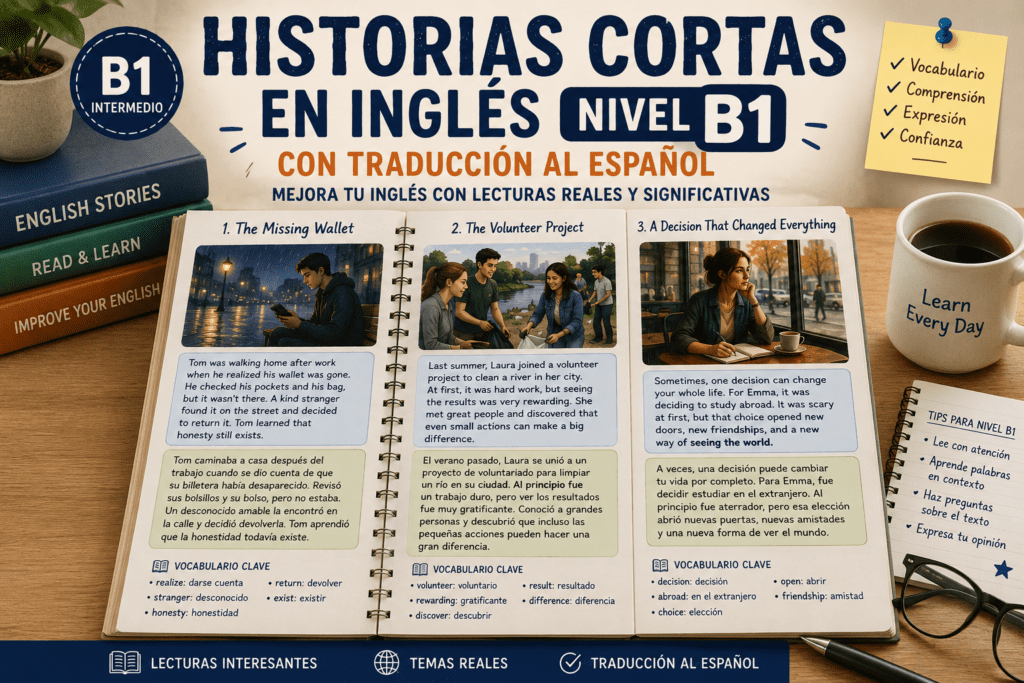
Historias cortas en inglés nivel B1 con traducción al español
7. The Last Train Home / El último tren a casa
Story in English
Mark arrived at the train station at 10:45 p.m. He was tired after a long day at work, and all he wanted was to go home.
The station was almost empty. A woman was closing a small coffee shop, and an old man was reading a newspaper on a bench.
Mark looked at the screen.
Last train: 10:50 p.m.
He checked his pocket for the ticket.
Nothing.
He checked his bag.
Nothing.
Then he remembered: the ticket was on his desk at the office.
“Oh no,” he whispered.
He went to the ticket machine, but it was not working. He looked around and saw the old man watching him.
“Problem?” the old man asked.
“I lost my ticket,” Mark said. “And this is the last train home.”
The old man folded his newspaper and stood up slowly.
“I have an extra ticket,” he said.
Mark looked surprised.
“Really?”
“Yes. My son was going to come with me, but he called and said he couldn’t.”
Mark took out his wallet.
“I can pay you.”
The old man shook his head.
“No. Just take it. One day, help someone else.”
The train arrived. Mark thanked him and got on.
Through the window, he saw the old man sitting on the bench again, alone but calm.
On the way home, Mark held the ticket in his hand and thought about those words.
The next morning, he bought two tickets before leaving the station.
One for himself.
And one, just in case someone else needed to get home.
Traducción al español
Mark llegó a la estación de tren a las 10:45 de la noche. Estaba cansado después de un largo día de trabajo y lo único que quería era volver a casa.
La estación estaba casi vacía. Una mujer cerraba una pequeña cafetería y un hombre mayor leía un periódico en un banco.
Mark miró la pantalla.
Último tren: 10:50 p.m.
Revisó su bolsillo buscando el boleto.
Nada.
Revisó su bolso.
Nada.
Entonces recordó: el boleto estaba sobre su escritorio en la oficina.
—Ay no —susurró.
Fue a la máquina de boletos, pero no funcionaba. Miró alrededor y vio que el hombre mayor lo observaba.
—¿Problema? —preguntó el hombre.
—Perdí mi boleto —dijo Mark—. Y este es el último tren a casa.
El hombre mayor dobló su periódico y se levantó lentamente.
—Tengo un boleto extra —dijo.
Mark lo miró sorprendido.
—¿De verdad?
—Sí. Mi hijo iba a venir conmigo, pero llamó y dijo que no podía.
Mark sacó su billetera.
—Puedo pagárselo.
El hombre negó con la cabeza.
—No. Solo tómelo. Un día, ayude a alguien más.
El tren llegó. Mark le dio las gracias y subió.
A través de la ventana, vio al hombre mayor sentado otra vez en el banco, solo pero tranquilo.
De camino a casa, Mark sostuvo el boleto en la mano y pensó en esas palabras.
A la mañana siguiente, compró dos boletos antes de salir de la estación.
Uno para él.
Y otro, por si alguien más necesitaba volver a casa.
Vocabulario clave
| English | Español |
|---|---|
| train station | estación de tren |
| tired | cansado |
| ticket | boleto / billete |
| bolsillo | |
| wallet | billetera |
| extra | extra |
| bench | banco |
| newspaper | periódico |
| get on | subir |
| just in case | por si acaso |
Frase útil
One day, help someone else.
Un día, ayuda a alguien más.
Preguntas de comprensión
- Why is Mark worried at the station?
- Who helps Mark?
- Why does the old man have an extra ticket?
- What does Mark do the next morning?
8. The Promise at the Park / La promesa en el parque
Story in English
When Lily and Emma were ten years old, they made a promise at the park.
They sat under a big tree near the lake and wrote their names on a small piece of paper.
“Best friends forever,” Emma said.
“Even if we live far away,” Lily added.
They put the paper inside a small glass bottle and buried it under the tree.
For years, they met at the same park every summer. They talked about school, books, music and dreams.
But when they were fifteen, Emma moved to another city. At first, they called each other every week. Then every month. Then almost never.
Life became busy.
Years passed.
One afternoon, Lily returned to the park. She was twenty now. The tree was still there, taller and wider. The lake was quiet.
She sat under the tree and remembered the promise. She smiled sadly and started to dig with her hands.
After a few minutes, she found the small bottle.
Inside, the paper was old but still there.
She opened it carefully.
There were their names, but also a sentence Lily had forgotten:
“If one of us forgets, the other will remember.”
Lily took a picture of the paper and sent it to Emma.
For a while, there was no answer.
Then her phone rang.
Emma’s voice sounded older, but happy.
“You remembered,” Emma said.
Lily looked at the tree.
“No,” she answered. “The park did.”
Traducción al español
Cuando Lily y Emma tenían diez años, hicieron una promesa en el parque.
Se sentaron bajo un árbol grande cerca del lago y escribieron sus nombres en un pequeño papel.
—Mejores amigas para siempre —dijo Emma.
—Aunque vivamos lejos —añadió Lily.
Pusieron el papel dentro de una pequeña botella de vidrio y la enterraron bajo el árbol.
Durante años, se reunieron en el mismo parque cada verano. Hablaban de la escuela, libros, música y sueños.
Pero cuando tenían quince años, Emma se mudó a otra ciudad. Al principio, se llamaban cada semana. Luego cada mes. Después casi nunca.
La vida se volvió ocupada.
Pasaron los años.
Una tarde, Lily volvió al parque. Tenía veinte años. El árbol seguía allí, más alto y más ancho. El lago estaba tranquilo.
Se sentó bajo el árbol y recordó la promesa. Sonrió con tristeza y empezó a cavar con las manos.
Después de unos minutos, encontró la pequeña botella.
Dentro, el papel estaba viejo, pero seguía allí.
Lo abrió con cuidado.
Estaban sus nombres, pero también una frase que Lily había olvidado:
“Si una de nosotras olvida, la otra recordará.”
Lily tomó una foto del papel y se la envió a Emma.
Durante un rato, no hubo respuesta.
Luego sonó su teléfono.
La voz de Emma sonaba más adulta, pero feliz.
—Recordaste —dijo Emma.
Lily miró el árbol.
—No —respondió—. El parque recordó.
Vocabulario clave
| English | Español |
|---|---|
| promise | promesa |
| park | parque |
| lake | lago |
| paper | papel |
| bottle | botella |
| bury | enterrar |
| move | mudarse |
| remember | recordar |
| forget | olvidar |
| phone rang | sonó el teléfono |
Frase útil
Even if we live far away.
Aunque vivamos lejos.
Preguntas de comprensión
- Where do Lily and Emma make their promise?
- What do they put inside the bottle?
- Why do they stop talking often?
- What sentence does Lily find on the paper?
9. The Notebook Nobody Opened / El cuaderno que nadie abrió
Story in English
There was an old notebook in the school library. It had a dark green cover and no title.
Nobody knew who left it there. It was always on the same shelf, between a dictionary and a book of poems.
Most students never noticed it.
But Daniel did.
One rainy afternoon, he sat near the window and saw the notebook on the shelf. He took it and opened the first page.
There was only one sentence:
“Write what you cannot say.”
Daniel closed the notebook quickly.
He was not scared, but he felt strange. That sentence seemed written for him.
For weeks, Daniel had been angry with his best friend, Alex. They had argued during a soccer game, and since then, neither of them had spoken.
Daniel wanted to say sorry, but he did not know how.
He opened the notebook again and wrote:
“I miss my friend, but I am too proud to talk first.”
The next day, he went back to the library. His words were still there, but under them, someone had written:
“Pride is heavy. Friendship is lighter.”
Daniel looked around. Nobody was near him.
He took the notebook and wrote:
“What should I do?”
This time, the answer appeared slowly, as if an invisible hand was writing:
“Start with one honest sentence.”
Daniel left the library and found Alex near the school gate.
He took a deep breath.
“I miss playing with you,” Daniel said.
Alex looked at him in silence.
Then he answered:
“Me too.”
The next afternoon, Daniel returned to the library. The notebook was gone.
In its place, there was a small note:
“Now you know what to say.”
Traducción al español
Había un cuaderno viejo en la biblioteca de la escuela. Tenía una tapa verde oscuro y ningún título.
Nadie sabía quién lo había dejado allí. Siempre estaba en el mismo estante, entre un diccionario y un libro de poemas.
La mayoría de los estudiantes nunca lo notaba.
Pero Daniel sí.
Una tarde lluviosa, se sentó cerca de la ventana y vio el cuaderno en el estante. Lo tomó y abrió la primera página.
Solo había una frase:
“Escribe lo que no puedes decir.”
Daniel cerró el cuaderno rápidamente.
No estaba asustado, pero se sintió extraño. Esa frase parecía escrita para él.
Durante semanas, Daniel había estado enojado con su mejor amigo, Alex. Habían discutido durante un partido de fútbol y, desde entonces, ninguno de los dos había hablado.
Daniel quería pedir perdón, pero no sabía cómo.
Abrió el cuaderno otra vez y escribió:
“Extraño a mi amigo, pero soy demasiado orgulloso para hablar primero.”
Al día siguiente, volvió a la biblioteca. Sus palabras seguían allí, pero debajo alguien había escrito:
“El orgullo pesa. La amistad es más ligera.”
Daniel miró alrededor. No había nadie cerca.
Tomó el cuaderno y escribió:
“¿Qué debo hacer?”
Esta vez, la respuesta apareció lentamente, como si una mano invisible escribiera:
“Empieza con una frase honesta.”
Daniel salió de la biblioteca y encontró a Alex cerca de la puerta de la escuela.
Respiró hondo.
—Extraño jugar contigo —dijo Daniel.
Alex lo miró en silencio.
Luego respondió:
—Yo también.
A la tarde siguiente, Daniel volvió a la biblioteca. El cuaderno ya no estaba.
En su lugar, había una pequeña nota:
“Ahora sabes qué decir.”
Vocabulario clave
| English | Español |
|---|---|
| notebook | cuaderno |
| library | biblioteca |
| shelf | estante |
| dictionary | diccionario |
| sentence | frase |
| argue | discutir |
| proud | orgulloso |
| friendship | amistad |
| honest | honesto |
| school gate | puerta de la escuela |
Frase útil
Start with one honest sentence.
Empieza con una frase honesta.
Preguntas de comprensión
- Where does Daniel find the notebook?
- Why is Daniel sad about Alex?
- What does the notebook tell him to do?
- What happens when Daniel talks to Alex?
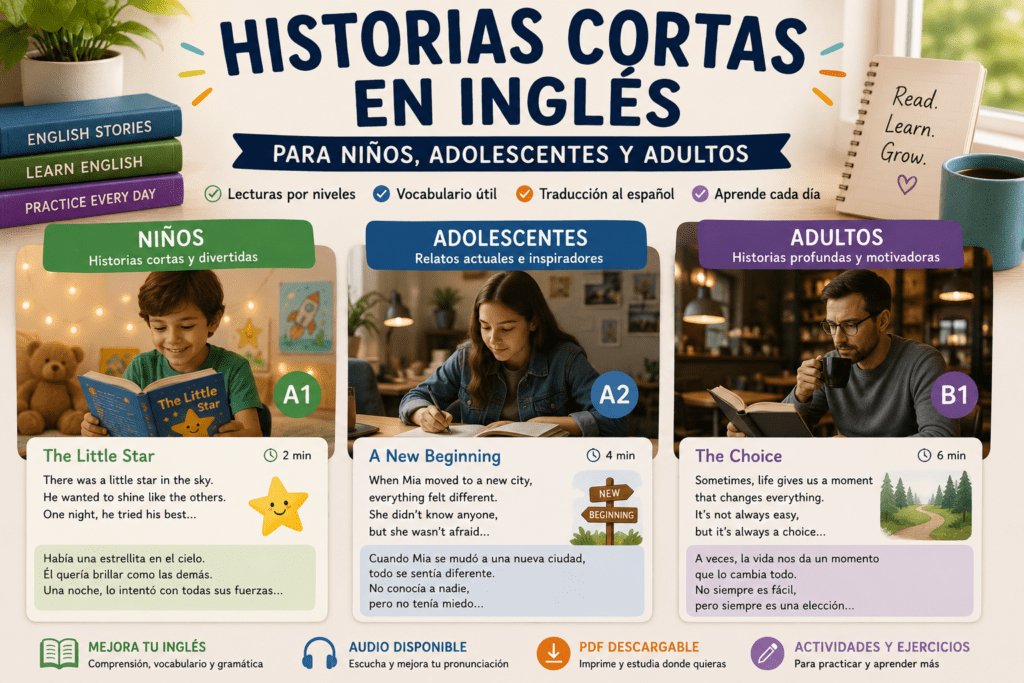
Historias cortas en inglés para niños, adolescentes y adultos
Para niños: The Blue Balloon / El globo azul
Story in English
Liam is in the park with his mother. It is a sunny day, and many children are playing.
Liam has a blue balloon. It is big and bright.
“I love my balloon,” Liam says.
He runs near the trees. The balloon moves in the wind.
“Be careful,” his mother says. “Hold it tight.”
Liam holds the string, but the wind is strong. Suddenly, the balloon flies out of his hand.
“Oh no!” Liam cries.
The blue balloon goes up, up, up into the sky.
Liam feels sad. He sits on a bench and looks at the clouds.
A little girl comes to him. She has two small balloons: one yellow and one red.
“Do you want one?” she asks.
Liam looks at her.
“But it is yours,” he says.
“I have two,” she answers. “Now we can both have one.”
Liam smiles and takes the red balloon.
“Thank you,” he says.
His mother sits next to him.
“You lost one balloon,” she says, “but you found a kind friend.”
Liam looks at the sky. The blue balloon is very small now, almost like a dot.
Then he looks at the red balloon in his hand.
He is happy again.
Traducción al español
Liam está en el parque con su madre. Es un día soleado y muchos niños están jugando.
Liam tiene un globo azul. Es grande y brillante.
—Me encanta mi globo —dice Liam.
Corre cerca de los árboles. El globo se mueve con el viento.
—Ten cuidado —dice su madre—. Sujétalo fuerte.
Liam sostiene la cuerda, pero el viento es fuerte. De repente, el globo se escapa de su mano.
—¡Ay no! —grita Liam.
El globo azul sube, sube, sube hacia el cielo.
Liam se siente triste. Se sienta en un banco y mira las nubes.
Una niña pequeña se acerca a él. Tiene dos globos pequeños: uno amarillo y uno rojo.
—¿Quieres uno? —pregunta.
Liam la mira.
—Pero es tuyo —dice.
—Tengo dos —responde ella—. Ahora los dos podemos tener uno.
Liam sonríe y toma el globo rojo.
—Gracias —dice.
Su madre se sienta junto a él.
—Perdiste un globo —dice—, pero encontraste una amiga amable.
Liam mira el cielo. El globo azul ya es muy pequeño, casi como un punto.
Luego mira el globo rojo en su mano.
Está feliz otra vez.
Vocabulario clave
| English | Español |
|---|---|
| balloon | globo |
| blue | azul |
| park | parque |
| mother | madre |
| sunny | soleado |
| wind | viento |
| string | cuerda |
| sky | cielo |
| bench | banco |
| friend | amigo/a |
Para adolescentes: The Exam Day / El día del examen
Story in English
Sofia has an English exam on Friday. She studies all week, but on Thursday night she feels nervous.
“What if I forget everything?” she says.
Her older brother, Leo, is at the kitchen table.
“You won’t forget everything,” he says. “You are just nervous.”
Sofia opens her notebook again. There are many words, grammar rules and examples. She reads one page, then another, but her mind feels tired.
Leo closes the notebook gently.
“Stop for ten minutes,” he says. “Drink water. Breathe. Then study only the parts you don’t understand.”
Sofia does not want to stop, but she listens.
After ten minutes, she feels better. She writes a short list:
- irregular verbs
- past simple
- reading questions
She studies only those three things.
The next morning, Sofia arrives at school early. Her hands are cold. Her friend Camila is nervous too.
“I didn’t sleep much,” Camila says.
“Me neither,” Sofia answers. “But we studied.”
When the exam starts, Sofia reads the first question slowly. She knows the answer.
Then the second.
Then the third.
She does not know everything, but she knows enough to continue.
At the end of the exam, she gives the paper to the teacher and smiles.
That afternoon, Leo asks:
“How was it?”
Sofia says:
“I was nervous, but I didn’t run away.”
Leo laughs.
“That is already a victory.”
Traducción al español
Sofía tiene un examen de inglés el viernes. Estudia toda la semana, pero el jueves por la noche se siente nerviosa.
—¿Y si se me olvida todo? —dice.
Su hermano mayor, Leo, está en la mesa de la cocina.
—No se te va a olvidar todo —dice—. Solo estás nerviosa.
Sofía abre su cuaderno otra vez. Hay muchas palabras, reglas de gramática y ejemplos. Lee una página, luego otra, pero su mente se siente cansada.
Leo cierra el cuaderno con cuidado.
—Detente diez minutos —dice—. Bebe agua. Respira. Luego estudia solo las partes que no entiendes.
Sofía no quiere detenerse, pero lo escucha.
Después de diez minutos, se siente mejor. Escribe una lista corta:
- verbos irregulares
- pasado simple
- preguntas de lectura
Estudia solo esas tres cosas.
A la mañana siguiente, Sofía llega temprano a la escuela. Tiene las manos frías. Su amiga Camila también está nerviosa.
—No dormí mucho —dice Camila.
—Yo tampoco —responde Sofía—. Pero estudiamos.
Cuando empieza el examen, Sofía lee la primera pregunta despacio. Sabe la respuesta.
Luego la segunda.
Luego la tercera.
No lo sabe todo, pero sabe lo suficiente para continuar.
Al final del examen, entrega la hoja a la profesora y sonríe.
Esa tarde, Leo pregunta:
—¿Cómo te fue?
Sofía dice:
—Estaba nerviosa, pero no salí corriendo.
Leo se ríe.
—Eso ya es una victoria.
Vocabulario clave
| English | Español |
|---|---|
| exam | examen |
| nervous | nervioso/a |
| forget | olvidar |
| notebook | cuaderno |
| grammar rules | reglas de gramática |
| tired | cansado/a |
| breathe | respirar |
| question | pregunta |
| answer | respuesta |
| victory | victoria |
Para adultos principiantes: The Coffee Shop / La cafetería
Story in English
Maria works near a small coffee shop. Every morning, she passes the door, but she never goes in.
She is learning English, and the menu is in English. She feels shy because she does not want to make a mistake.
One morning, she stops outside the coffee shop and reads the sign:
Coffee, tea, sandwiches, cake.
“I know these words,” she thinks.
She opens the door.
A man behind the counter smiles.
“Good morning. What would you like?”
Maria feels nervous, but she remembers a phrase from her English class.
“I would like a coffee, please.”
“Small or large?” the man asks.
Maria thinks for a second.
“Small, please.”
“Anything else?”
Maria looks at the menu. She sees the word “cake.”
“And a piece of cake, please.”
The man smiles.
“Sure.”
Maria pays and sits near the window. She takes a sip of coffee and feels proud.
It was a small conversation, but it was real.
The next morning, she goes to the coffee shop again.
This time, she tries a new sentence.
“Can I have tea today, please?”
The man nods.
“Of course.”
Maria smiles.
Learning English is not only in books. Sometimes it starts with a coffee.
Traducción al español
María trabaja cerca de una pequeña cafetería. Cada mañana pasa por la puerta, pero nunca entra.
Está aprendiendo inglés y el menú está en inglés. Le da vergüenza porque no quiere equivocarse.
Una mañana, se detiene fuera de la cafetería y lee el cartel:
Café, té, sándwiches, pastel.
—Conozco estas palabras —piensa.
Abre la puerta.
Un hombre detrás del mostrador sonríe.
—Buenos días. ¿Qué le gustaría?
María se siente nerviosa, pero recuerda una frase de su clase de inglés.
—Quisiera un café, por favor.
—¿Pequeño o grande? —pregunta el hombre.
María piensa un segundo.
—Pequeño, por favor.
—¿Algo más?
María mira el menú. Ve la palabra “cake”.
—Y un trozo de pastel, por favor.
El hombre sonríe.
—Claro.
María paga y se sienta cerca de la ventana. Toma un sorbo de café y se siente orgullosa.
Fue una conversación pequeña, pero fue real.
A la mañana siguiente, vuelve a la cafetería.
Esta vez intenta una frase nueva.
—¿Puedo tomar té hoy, por favor?
El hombre asiente.
—Por supuesto.
María sonríe.
Aprender inglés no está solo en los libros. A veces empieza con un café.
Vocabulario clave
| English | Español |
|---|---|
| coffee shop | cafetería |
| menu | menú |
| shy | tímido/a |
| mistake | error |
| counter | mostrador |
| small | pequeño |
| large | grande |
| cake | pastel |
| pay | pagar |
| proud | orgulloso/a |
Vocabulario básico para entender mejor las historias
Palabras frecuentes en historias A1
Estas palabras aparecen mucho en historias sencillas en inglés. Son útiles para leer textos básicos sobre casa, escuela, familia, animales y rutinas.
| English | Español |
|---|---|
| house | casa |
| school | escuela |
| friend | amigo/a |
| family | familia |
| mother | madre |
| father | padre |
| dog | perro |
| cat | gato |
| key | llave |
| door | puerta |
| table | mesa |
| chair | silla |
| morning | mañana |
| happy | feliz |
| sad | triste |
| look | mirar |
| go | ir |
| take | tomar / llevar |
| help | ayudar |
| home | hogar / casa |
Frase útil A1:
I am at home.
Estoy en casa.
Ejemplo:
The dog is near the door.
El perro está cerca de la puerta.
Palabras frecuentes en historias A2
En nivel A2 ya aparecen acciones más claras, pequeños problemas y situaciones cotidianas. Estas palabras ayudan a entender historias sobre escuela, vecinos, familia, viajes cortos o errores simples.
| English | Español |
|---|---|
| neighbor | vecino/a |
| backpack | mochila |
| mistake | error |
| letter | carta |
| visit | visitar |
| wait | esperar |
| remember | recordar |
| forget | olvidar |
| carry | cargar / llevar |
| call | llamar |
| arrive | llegar |
| leave | salir / dejar |
| answer | responder |
| question | pregunta |
| nervous | nervioso/a |
| tired | cansado/a |
| quickly | rápidamente |
| slowly | lentamente |
| together | juntos |
| before | antes |
Frase útil A2:
Do you need help?
¿Necesitas ayuda?
Ejemplo:
The new neighbor needs help with a box.
El nuevo vecino necesita ayuda con una caja.
Palabras frecuentes en historias B1
En nivel B1 las historias tienen más detalle. Aparecen conectores, emociones, decisiones y frases con más contexto.
| English | Español |
|---|---|
| promise | promesa |
| suddenly | de repente |
| although | aunque |
| before | antes |
| after | después |
| realize | darse cuenta |
| decide | decidir |
| discover | descubrir |
| however | sin embargo |
| because | porque |
| while | mientras |
| until | hasta que |
| proud | orgulloso/a |
| worried | preocupado/a |
| alone | solo/a |
| calm | tranquilo/a |
| mistake | error |
| honest | honesto/a |
| friendship | amistad |
| just in case | por si acaso |
Frase útil B1:
Start with one honest sentence.
Empieza con una frase honesta.
Ejemplo:
Although Daniel was nervous, he decided to talk to his friend.
Aunque Daniel estaba nervioso, decidió hablar con su amigo.
Cómo leer una historia corta en inglés sin traducir palabra por palabra
Lee primero la idea general
No intentes entender cada palabra en la primera lectura. Primero busca la idea principal:
- ¿Quién aparece en la historia?
- ¿Dónde ocurre?
- ¿Qué problema hay?
- ¿Qué cambia al final?
Ejemplo:
Anna cannot find her key.
Anna no puede encontrar su llave.
Aunque no entiendas todas las palabras, ya sabes lo importante: Anna tiene un problema con una llave.
Usa la traducción solo después de intentar leer
Cuando leo una historia en inglés, intento aguantar la primera lectura sin traducir todo. Luego uso la versión en español para confirmar lo que entendí.
Orden recomendado:
- Lee el texto en inglés.
- Marca 3–5 palabras que no entiendes.
- Intenta adivinar por contexto.
- Revisa la traducción.
- Vuelve a leer el texto en inglés.
Así no dependes de la traducción desde el primer segundo.
Repite una frase útil de cada historia
Después de leer, quédate con una frase corta que puedas usar en una conversación real.
Ejemplos:
I am late.
Voy tarde.
Do you need help?
¿Necesitas ayuda?
It made my day.
Me alegró el día.
Start with one honest sentence.
Empieza con una frase honesta.
Mi consejo: repite la frase en voz alta tres veces. No hace falta memorizar toda la historia; una frase bien aprendida ya sirve.
Responde las preguntas sin mirar la traducción
Después de cada historia, intenta responder primero en inglés sencillo.
Ejemplo:
Question: Where is the key?
Answer: The key is in the door.
Luego puedes revisar la traducción para confirmar.
No busques respuestas perfectas. Busca respuestas claras. Para practicar lectura, una frase simple funciona mejor que quedarse bloqueado intentando escribir algo demasiado largo.
Actividades rápidas con historias cortas en inglés
Actividad 1: subraya 5 palabras nuevas
Elige una historia y subraya solo 5 palabras nuevas. No marques todo el texto, porque eso vuelve la lectura pesada.
Ejemplo con The Lost Key:
- key
- door
- bag
- late
- look for
Después escribe la traducción al lado:
| English | Español |
|---|---|
| key | llave |
| door | puerta |
| bag | mochila / bolso |
| late | tarde |
| look for | buscar |
Actividad 2: escribe una frase con cada palabra
Usa las palabras nuevas para crear frases simples.
Ejemplos:
Key:
I have a key.
Tengo una llave.
Door:
The door is open.
La puerta está abierta.
Bag:
My book is in my bag.
Mi libro está en mi mochila.
Late:
I am late for school.
Llego tarde a la escuela.
Look for:
I look for my notebook.
Busco mi cuaderno.
Actividad 3: cambia el final de la historia
Elige una historia y escribe un final diferente en español o en inglés sencillo.
Ejemplo con The Small Dog:
Final original:
Emma encuentra al dueño de Max y el perro vuelve a casa.
Final nuevo:
Emma y su padre llevan a Max a una veterinaria. Allí descubren que el perro pertenece a una familia que vive cerca del parque.
Esta actividad ayuda a practicar comprensión, creatividad y estructura narrativa. Para trabajar mejor las partes del relato, puedes usar estos ejemplos de historias cortas con inicio, nudo y desenlace.
Actividad 4: resume la historia en español
Después de leer, resume la historia en 3 líneas.
Ejemplo con A Rainy Morning:
Tom no quiere salir porque está lloviendo.
De camino a la escuela encuentra un gato mojado.
Usa su paraguas para ayudarlo y descubre que un día lluvioso también puede tener algo bueno.
Actividad 5: responde en inglés con frases simples
No necesitas respuestas largas. Usa frases cortas.
Ejemplo:
Question: What does Tom see under a tree?
Answer: Tom sees a small cat.
Question: Where is Anna’s key?
Answer: The key is in the door.
Question: Who helps Sofia in class?
Answer: Mia helps Sofia.
Actividad 6: convierte una frase al plural o al pasado
Toma una frase de la historia y cámbiala.
Frase original:
The dog is in the park.
Plural:
The dogs are in the park.
Pasado:
The dog was in the park.
Otro ejemplo:
Frase original:
Anna looks for her key.
Pasado:
Anna looked for her key.
Actividad 7: lee en voz alta una frase útil
Elige una frase útil y repítela tres veces.
Ejemplos:
Do you need help?
¿Necesitas ayuda?
I am late.
Voy tarde.
It made my day.
Me alegró el día.
Start with one honest sentence.
Empieza con una frase honesta.
La idea no es memorizar todo el texto. Es quedarte con frases que puedas usar después.
Diferencias entre historias en inglés, cuentos en inglés y PDF descargable
Historias cortas en inglés con traducción
Las historias cortas en inglés con traducción al español están pensadas para practicar lectura sin perder el sentido del texto. Aquí lees primero en inglés y luego revisas la versión en español para confirmar lo que entendiste.
Este formato sirve si quieres:
- Mejorar comprensión lectora.
- Aprender vocabulario en contexto.
- Practicar frases útiles.
- Leer sin depender todo el tiempo del diccionario.
- Usar historias breves en clase o en casa.
Ejemplo:
The key is in the door.
La llave está en la puerta.
La ventaja es que ves la frase dentro de una historia, no como una palabra suelta.
Cuentos cortos en inglés con traducción
Los cuentos cortos en inglés con traducción suelen tener un tono más narrativo o clásico. Pueden incluir personajes, conflictos, moralejas y finales más marcados.
La diferencia principal es esta:
- Una historia corta en inglés puede ser cotidiana: una llave perdida, una carta, una cafetería o un examen.
- Un cuento corto en inglés suele sentirse más literario: animales que hablan, una enseñanza final, una aventura o una situación de fantasía.
En este artículo usamos ambos enfoques cuando aportan valor, pero sin complicar la lectura. La prioridad es que el texto sea fácil de leer, entender y practicar.
PDF de cuentos cortos en inglés con traducción
El PDF funciona mejor como complemento. Sirve si quieres guardar las lecturas, imprimirlas o usarlas en clase sin conexión.
Puedes usar el PDF para:
- Imprimir historias.
- Trabajar vocabulario.
- Hacer ejercicios de comprensión.
- Leer en familia.
- Preparar actividades escolares.
Mi recomendación es simple: lee primero las historias aquí, con traducción y vocabulario. Luego usa el PDF si quieres practicar fuera de la página o llevar las lecturas al aula.
Preguntas frecuentes sobre historias cortas en inglés con traducción
¿Qué nivel de inglés necesito para leer estas historias?
Puedes empezar desde nivel A1. Las historias A1 usan frases simples, vocabulario básico y situaciones fáciles de entender.
Si ya conoces palabras comunes y puedes leer frases cortas, empieza por The Lost Key, A Rainy Morning o The Small Dog.
¿Es mejor leer primero en inglés o en español?
Lo mejor es leer primero en inglés, aunque no entiendas todo. Después revisa la traducción al español para confirmar.
- Lee en inglés.
- Intenta entender la idea general.
- Mira la traducción.
- Relee el texto en inglés.
- Repite una frase útil en voz alta.
¿Estas historias sirven para niños?
Sí. Las historias A1 funcionan bien para niños porque tienen frases cortas, vocabulario sencillo y situaciones claras.
Para niños, recomiendo empezar con:
- The Blue Balloon
- The Small Dog
- A Rainy Morning
¿También sirven para adultos principiantes?
Sí. No todas las historias en inglés deben ser infantiles. Por eso también incluimos relatos cotidianos como The Coffee Shop, The Last Train Home o A Letter from Grandma.
Son útiles para practicar frases reales: pedir algo, ayudar a alguien, hablar de rutinas, contar una situación o comprender un diálogo simple.
¿Cómo aprender vocabulario con historias cortas?
No intentes memorizar todas las palabras. Elige solo 5 o 6 palabras nuevas por historia y escribe una frase con cada una.
| English | Español |
|---|---|
| key | llave |
| door | puerta |
| late | tarde |
| look for | buscar |
| help | ayudar |
Busco mi llave.
¿Puedo usar estas historias en clase?
Sí. Puedes usarlas para lectura, vocabulario, traducción, comprensión y escritura breve.
- Leer la historia en inglés.
- Subrayar palabras nuevas.
- Leer la traducción.
- Responder preguntas.
- Cambiar el final en una frase.
¿Hay historias cortas en inglés con PDF?
Sí. El PDF debe usarse como complemento para imprimir o practicar fuera de la página.
Puedes leer primero las historias aquí y luego usar el recurso descargable si quieres trabajar en clase, repasar vocabulario o guardar las lecturas.
¿Cuánto debe durar una historia corta en inglés?
Para practicar inglés, lo ideal es que dure entre 2 y 5 minutos.
- A1: 2 minutos.
- A2: 3 minutos.
- B1: 4 o 5 minutos.

Yo soy Betty, autora y curadora de este espacio. Trabajo con el método Leer · Destilar · Contar: leo versiones clásicas y modernas, destilo el corazón del relato y lo cuento con lenguaje claro, respetando el sentido original y proponiendo valores trabajables.
Prioritizo dominio público cuando corresponde y señalo la adaptación cuando la realizo. En cada pieza indico edad y tiempo de lectura, y cuando aporta valor agrego PDF, audio y preguntas de comprensión. Actualizo contenidos de manera periódica; si realizo cambios relevantes, los marco en la página. Si detectas algo mejorable, puedes decírmelo: mi objetivo es que cada lectura acompañe y enseñe con rigor y calidez.