
Works of Pindar: hymns and odes of the Greek poet
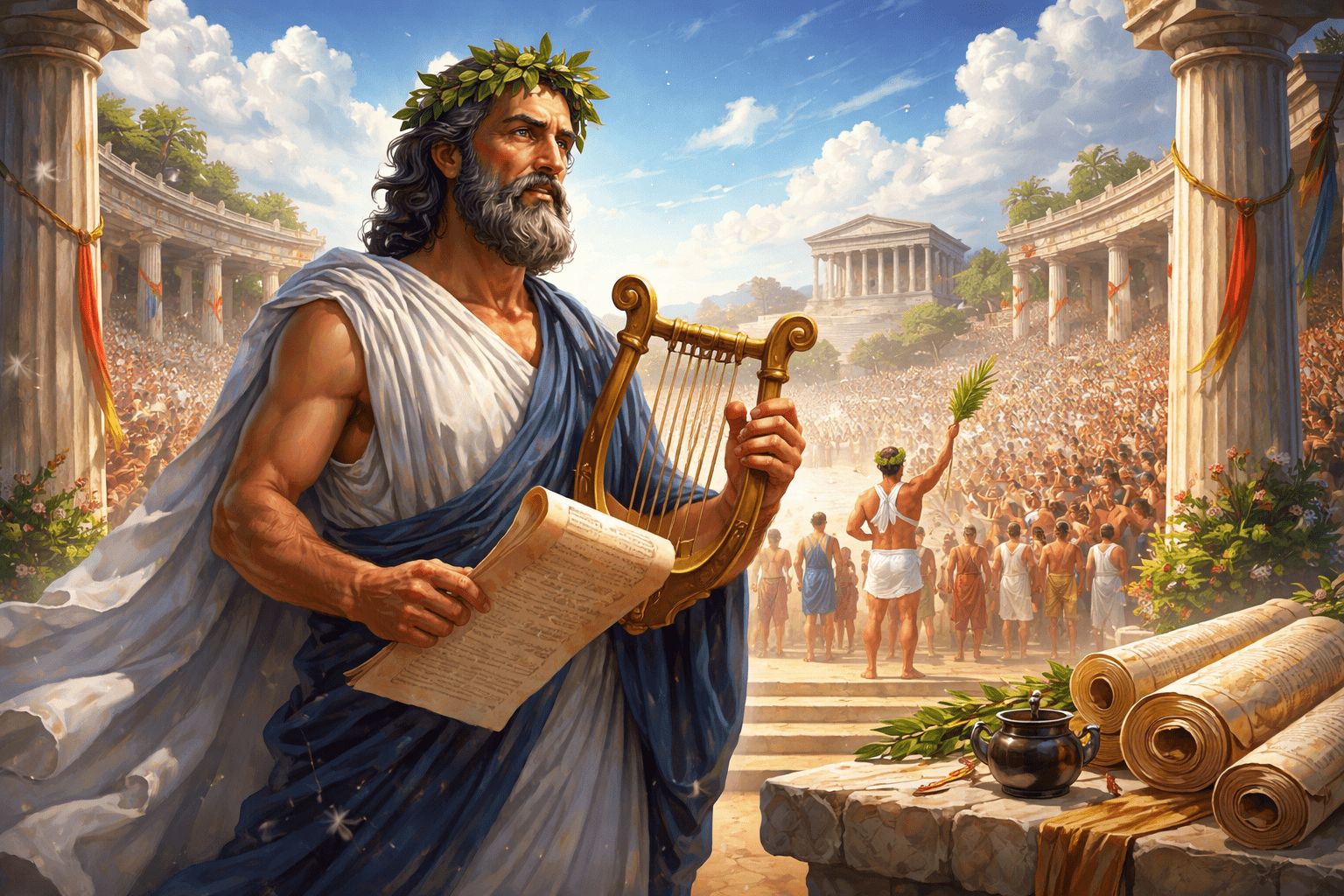
Pindar's works in 30 seconds
When someone searches for “ works of Pindar ,” they are almost always asking for something very specific: what he wrote (or what survives), how it is organized, and where to begin . I explain it like this, without complicating things:
Express summary (5 bullet points)
- The main focus in Pindar is on victory odesPoems composed to celebrate triumphs in major competitions, with praise, myth, and a final idea that "closes" the celebration.
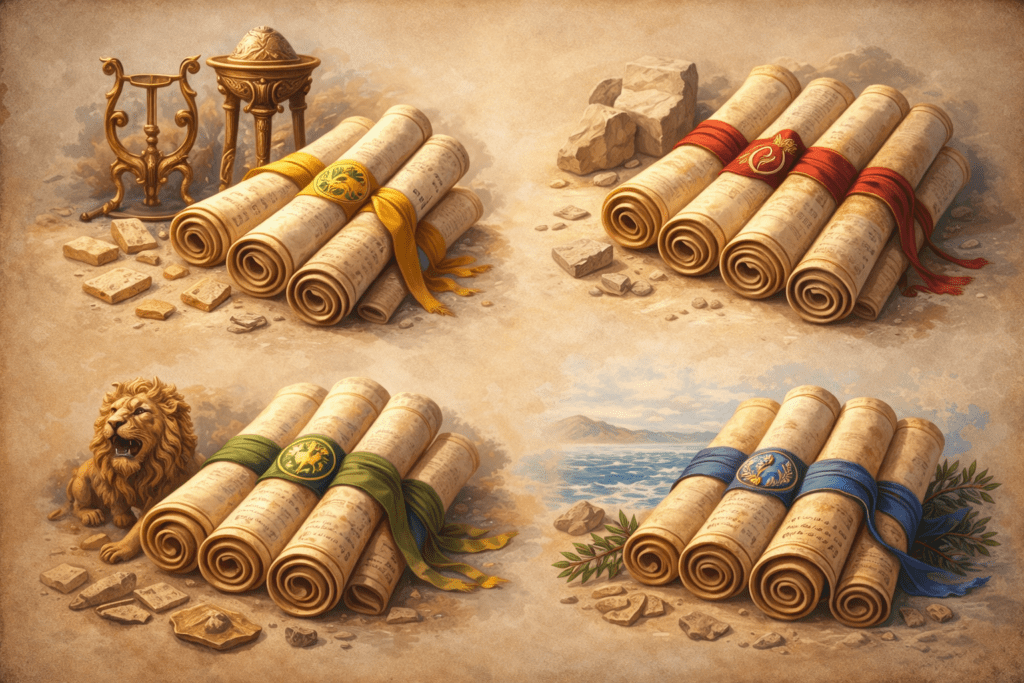
- These odes are grouped into four sets that function as “books”: Olympians, Pythians, Nemeans and IsthmiansThat is the heart of his fame.
- In addition to victory odes, he is credited with hymns and other songs (of ritual or celebratory function), but They are not preserved in the same complete condition.
- Part of its production arrives in fragments: incomplete texts or texts cited by other sources; they read well if you accept their "partial" nature and do not try to fill in what is missing.
- For a first reading, I recommend not starting "blindly": the best access is a model ode (to understand the structure) and only then expand by topic.
Practical tip: If you can only focus on one idea to study, in a Pindaric ode I always look for (1) who wins, (2) which myth is introduced, and (3) what value or lesson remains at the end . With that, you can explain the meaning without having to memorize everything.
Clickable index by type (to navigate without getting lost)
I will elaborate on this in more detail in the rest of the article, but here's the basic guideline:
- Victory odes (epinicias)
- Olympic
- pythics
- Nemean
- Isthmian
- Hymns and other songs (attributed/preserved unevenly)
- Fragments (how to read the incomplete without inventing)
- How to read Pindar without being a Hellenist (practical method)
- 7 odes to get started (guided selection, without complete verses)
- Summary tables for studying (quick maps)
- FAQ (real doubts about reading and exams)
Practical tip: If you're here for an exam or to analyze a text, it's not a good idea to open an entire ode and try to "understand it all" in one sitting. What works for me is to divide the reading into 3 quick passes:
- context switch (winner/city/occasion),
- structure pass (praise → myth → return),
- closing pass (what lesson it teaches).
It's amazing how much clearer that order makes things.
What this guide promises (and what it doesn't)
To avoid any misconceptions:
- Yes, you will find it here: a clear map of the corpus, differences between groups of odes, reading paths, templates for studying, and a system for commenting without drowning in myths.
- You are not going to find“Complete odes to copy” or a long anthology of texts. I prefer this page to be a useful and clean guide, not a repository.
Practical tip: If you're just starting out, your goal isn't to "understand everything" on the first reading. Your goal is to recognize the pattern: celebration → mythical example → final idea . Once that pattern becomes familiar, Pindar stops seeming like a labyrinth.
Complete list and classification of Pindar's works
When I organize Pindar for a guide to his works, I don't start with dates or theory: I start with what we have in our hands today. That avoids the typical writer's block of "I don't understand what I'm reading or why everything is jumping out at me."
What remains today
The most useful thing is to separate your production into three large boxes:
1) Odes of victory
These are the pieces that uphold his fame and best answer searches such as “odes by Pindar”. They are grouped into four sets:
- Olympic
- pythics
- Nemean
- Isthmian
2) Hymns and other songs
This includes what are often referred to as “hymns,” “paeans,” “dithyrambs,” and other celebratory or ritual forms. The key idea is this: they do not survive with the same completeness as victory odes, and are frequently studied as remnants (attributions, fragments, testimonies).
3) Fragments
It's not a minor category: it's an editorial reality. I read them as "windows" to themes and tones, not as pieces that have to be forced to be complete.
Mini practical tip: Before you begin, decide on your goal in one sentence:
- “I want to understand the Pindaric ode model” → begins with victory odes.
- “I want to broaden my perspective” → Visit hymns and excerpts later, when you recognize the pattern.
What is an epinicia ode explained for readers
An epinician ode is, in essence, a poem composed to celebrate a victory . But the important thing is not the sporting fact; what is important is the function: the ode transforms the triumph into memory , and the memory into prestige.
I understand it with three very simple ideas:
1) It is a poem with a recipient
He does not write "into the air": he writes for a victor, a family, or a city that wants the triumph to be recorded.
2) He not only praises, he also teaches
Praise is not empty flattery: it usually includes a concluding thought about virtue, fortune, the limits of pride, time, destiny, and reputation. The ode celebrates, yes, but it also establishes values.
3) The myth is included as an example
Myth is not there to "decorate" or to mislead: it serves to justify and elevate what is being celebrated. In Pindar, myth functions as "proof" that this type of excellence has a place in a larger tradition.
Mini practical tip: When an ode seems "scattered," do this in the margin:
- Praise: What exactly is being celebrated?
- Myth: What example is being invoked and for what purpose?
- Closing: What value or warning does it leave you with?
With that triangle, the text ceases to be a labyrinth and becomes a structure.
Note for readers coming from other classics
If you're used to epics, my recommendation is to adjust your expectations: you're not following a long story here, you're reading a piece that moves in leaps (praise ↔ myth ↔ return to the victor) and whose driving force is the ending. If it helps to compare reading methods among classics, I also use this same "map + pattern" approach in Homer's works.
Pindar's victory odes
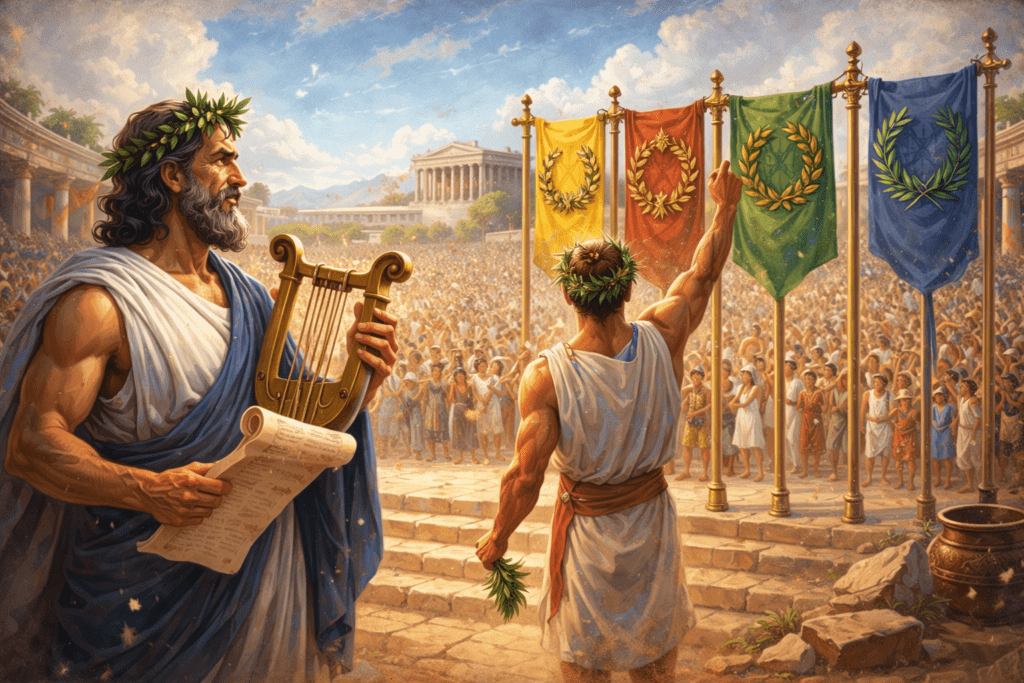
If Pindar remains a part of literary discourse, it's not because of a single "book," but because of this collection of celebratory poems: the victory odes . I read them as a kind of verbal ceremony: they don't simply recount a triumph, but transform it into memory (and memory into prestige). That's why, when someone searches for "Pindar's odes," they almost always end up here, even if they don't realize it.
Before separating the Olympian, Pythian, Nemean, and Isthmian baptisms, I'll share an idea that gives my work order:
The ode does not progress like a story, advances through movementsIt usually goes through these steps:
- Praise of the victor (who, what, for whom does it count)
- Mito (not as decoration: as an example that justifies and elevates)
- ROI to the victor (victory returns to the center)
- Closing (a final idea: virtue, fortune, limit, fame, time…)
Practical tip: If you get lost on the first reading, don't fight the text. Do the opposite: look for the ending first and ask yourself, "What is it trying to tell me?" Then reread it, and everything will fall into place better.
Olympic
The Olympics often feel like a "natural entry point" because their cultural renown is enormous and the framework of the celebration is easy to imagine: victory, honor, city, name. For me, they serve as a model for learning the Pindaric pattern.
Mini-sheet (template)
- What are they celebrating? triumphs linked to the highest prestige (victory as a symbol of excellence).
- Typical structure: clear praise → exemplary myth → return to the victor → courageous closing.
- What to look for: how is it built glory without falling into arrogance (and how to set a limit).
- Difficulty level: usually middle fingerThe myth may take up a lot of space, but the celebratory setting helps.
- Frequent closure: a phrase that orders the triumph within a value (virtue, prudence, memory).
Practical tip: In the Olympics, I mentally underline the "moment of return": that's where you see what the myth was for.
pythics
The Pythian oracles tend to give more weight to the cultural context and the symbolic significance of place and tradition. In practical reading, they sometimes feel more "reflective" or "dense," not because of obscurity, but because of their layers.
Mini-sheet (template)
- What are they celebrating? victories with a prestigious setting, often with strong cultural/ritual resonances.
- Typical structure: praise → myth with moral emphasis → return with city/family identity → closing with warning or balance.
- What to look for: el tone: how the praise can sound more solemn or more meditative.
- Difficulty level: medium-high if the myth is long and the topic jumps quickly.
- Frequent closure: an idea that balances greatness and limitation (fame needs virtue, fortune revolves, etc.).
Practical tip: When you don't understand a jump, ask yourself a simple question: "Is this elevating the victor or is it marking a limit ?" In the Pythian Mountains, it's almost always one of those two.
Nemean
The Nemean poems are excellent for training the reading eye because the Pindaric "movement" (praise ↔ myth ↔ return) is usually quite noticeable. I use them as a kind of exercise: you learn to detect structure.
Mini-sheet (template)
- What are they celebrating? triumphs that connect with civic pride and lineage (identity).
- Typical structure: praise → myth (as a mirror) → return to the victor → closure as a lesson.
- What to look for: How the poem “proves” excellence: it doesn’t just say “it is great”, it shows “why it deserves to be remembered”.
- Difficulty level: middle finger (very useful for practicing structural reading).
- Frequent closure: a conclusion that sounds like a “rule of life” (virtue, measure, honor, permanence).
Practical tip: In Nemean, write just one line: “Myth enters to prove ___.” That sentence will save you from a text commentary.
Isthmian
The Isthmian calendar, for me, works very well when you want to read with a clear compass: who is being celebrated and what value remains. In a studio setting, they are a good area for practicing closing statements and conclusions.
Mini-sheet (template)
- What are they celebrating? triumphs where the social environment (family/city) weighs as much as the individual.
- Typical structure: praise → brief or concentrated myth → return → closing with courage or warning.
- What to look for: el equilibrium between the individual and the community (how victory “belongs” to an identity).
- Difficulty level: low-medium if the myth is more concentrated; middle finger if it expands.
- Frequent closure: clear instruction (ideal for “exam mode”).
Practical tip: if you are going to study, choose an Isthmian to practice “response in 6 lines”: theme, structure, myth, return, closure, interpretation.
A shortcut that works for me for any victory ode
If you only have 5 minutes, apply this checklist (without getting bogged down in the details):
- Who wins (and who cares)
- Which myth enters (and what does it prove)
- Where the poem returns (return to the victor)
- What the closure leaves behind (value / warning / lesson)
Once you've mastered that, you can move on to more refined readings.
Hymns and other songs attributed to Pindar
When one hears "Pindar," one almost always thinks of victory odes. But if your intention is to understand his works as a whole, it's worth opening a second door: the non-epinic songs (those that don't celebrate athletic victories). Herein lies the key point—and I always emphasize this so as not to confuse the reader—: not everything survives complete , and not everything is preserved with the same certainty or extent.
Therefore, this section is not a "list to memorize", but a guide to help you understand what types of texts appear , what their function was, and how to read them without frustration.
Hymns, paeans and dithyrambs
In editions and studies, a group of lyrical forms often appears associated with religious or ritual celebrations. In practical reading, what matters to me is not the label, but the function.
- Hymns: texts of praise or invocation (think: “singing to a deity” or celebrating a sacred presence).
- Peanes: songs linked to protection, healing or ceremonial purposes (often associated with community contexts).
- Dithyrambs: songs of a more festive and choral tone, linked to ritual celebrations (and, in general, to a more exuberant energy).
How I read them (quick signs):
- destinatario: Who is invoked or celebrated?
- Function: Praise, petition, thanksgiving, public celebration?
- Tone: Solemn, festive, exhortative, communal?
Practical tip: If the text seems "less narrative" than a victory ode, don't force it to tell a story. Read it as a piece of theater : it serves to invoke, celebrate, or organize values within a community.
Fragments and lost works
This is where the "editorial side" comes in, which many competitors don't explain well: some of what is attributed to Pindar reaches us as fragments (quotes, remnants, incomplete passages). And that changes the way we read.
I translate this into a simple rule: a fragment is not commented on as a complete work . It is commented on as evidence of:
- un theme (what he is celebrating or saying),
- un tone (which emotion or register dominates),
- and a function (what is the purpose of that song).
How to read what is incomplete without inventing what is missing
When working on fragments, I follow this mini-protocol to avoid two typical mistakes (filling or exaggerating):
- What I can confirm:
- what it talks about (central theme),
- how it sounds (tone),
- what it attempts to do (function: to praise, to invoke, to advise, to warn).
- What not to say:
- “the complete story”,
- “the total intention”,
- “how it ended” (if it is not preserved).
- How I turn it into learning:
- I connect it with a recurring value (glory, limit, virtue, fortune, memory),
- and I compare it to the pattern of victory odes (when relevant).
Practical tip: If you're going to study fragments, make a 3-line note:
- Function: (invokes / celebrates / exhorts)
- Topic: (virtue / glory / destiny / community…)
- Tone: (solemn / festive / admonitory)
With that, you can now comment rigorously without "filling in" what's missing.
In short: outside of the victory odes, the Pindar that has come down to us is more uneven, but no less valuable. For me, it helps complete the picture: you see the poet not only as a celebrant of triumphs, but as a choral, ritualistic, and communal voice—and you learn to read the fragmentary with method, not with anxiety.
How to read Pindar without being a Hellenist
Let me tell you how I work with it: Pindar isn't "deciphered" by suffering through it line by line. He becomes understandable when you learn to recognize his movement (praise → myth → return → closure) and when you accept that the myth isn't a "story within the poem," but an example that underpins the celebration.
3-3-1 Method (that's how I read it)
This method is my shortcut to reading quickly and, above all, to studying without memorizing.
3 data points (minimal context)
- WinnerWho is being celebrated?
- City / lineageWhat identity is being reinforced?
- Second HandWhat kind of victory or prestige are you aiming for?
3 signals (structure)
- Entry of the mythWhen and why does it appear?
- Return to the victorWhere does the poem return to triumph?
- ClosingWhat value or warning does it leave?
1 final sentence (your base comment)
- “This ode celebrates ___ using the myth of ___ to affirm that ___.”
Practical tip: If you only have 10 minutes to prepare an ode, write the "final sentence" and then fill in the 3 facts and 3 signs. It's much more efficient than summarizing "everything that happens."
Reading signals that always work
This is where, in my experience, the reading becomes clear. I focus on four "clues" that are almost always present:
1) The voice: praise with purpose
It's not a neutral voice: it's building prestige. Simple question:
- What do you want us to remember about the victor? (virtue, lineage, discipline, divine favor, fame)
2) The leap into myth: it is not a whim
Myth is used to justify or glorify victory. Two common uses:
- Example of excellence"Look how greatness has precedents."
- Limit or warning"Glory needs measure; fortune turns."
3) The return: the poem regains its power
When the myth ends (or is cut short), the text returns to the victor to "settle the account".
- If you don't find the way back, you're left with the feeling of "I got lost in the myth".
4) The closing: here is the exam
Even if the body moves, the ending usually leaves an organizing idea:
- virtue, prudence, limit of pride, time, memory, fortune, fame.
Practical tip: my trick when something gets complicated is to read it in reverse: first the conclusion , then I go back to the myth, and finally to the initial praise. It sounds strange, but it reveals the intention.
Useful minimum glossary
I don't want this to become theory; just what's necessary to understand and study:
- Epinician Ode: poem celebrating a victory (with praise + myth + closing).
- Praise: praise (not just "flattery", but building prestige).
- Chorus: collective voice (think of public singing, not private reading).
- Exemplary myth: myth used as an example to support an idea (not as decoration).
- Earring: excellence/virtue (that which makes the triumph “worthy”).
- hybris: excess/pride that crosses limits (usually appears as a warning).
Practical tip: With Pindar, memorizing terms is less helpful than memorizing functions. If you know "what the myth is for" and "what the closing leaves behind," you're already in.
Typical mistakes when reading Pindar and how to avoid them
It happened to me at the beginning, and I've seen it repeated by students: Pindar isn't "difficult" because of gratuitous obscurity; he becomes difficult when you approach him with the wrong method. These are the three most common traps… and how I defuse them.
“I get lost with myths”
What happens is: you try to understand the myth as if it were a story that must be followed in its entirety, and then you drown in names, genealogies, or episodes that you don't recognize.
How I solve it (without being an encyclopedia):
- I don't read myth as history, but as function. I wonder:
- What is justifying the myth here?
Typical options: glory, lineage, virtue, limit of pride, luck, the memory.
- What is justifying the myth here?
- I'm left with one idea from the myth, not the whole myth.
The myth can almost always be summarized as: “This example shows that ____.” - I seek the return of the victor.
That point confirms for me what the myth was used for.
Practical advice: If you get lost, make a one-line note:
“The myth comes in to prove ____.”
With that, you already have a defensible interpretation without inventing anything.
“I don’t understand why he’s changing the subject.”
What happens is this: you come from a linear reading experience (novel, essay, even epic) and expect continuity. But the Pindaric ode works through movement , not continuity.
How do I solve it?
- I mark it as if it were music (not theory, just order):
A) Praise → B) Myth → C) Return → D) Closure - When there is a jump, it is almost always one of these two:
- Jump to lift: the poem rises from the particular (victor) to the exemplary (myth).
- Jump to sort valuesThe poem shifts focus to leave a final idea (virtue, prudence, limit, fame).
Practical advice: Write the following letters in the margin (or mentally): A / B / C / D.
If you can't label a part, don't "force" it: keep reading until you find the closureand then you come back.
“Starting overwhelms me”
What happens is: you want to understand everything in the first ode and end up frustrated. Pindar isn't won over by brute force: he's won over by pattern.
I recommend the shortest route (without complicating things):
- Choose 1 "model" ode (from the best known or most accessible ones in your edition).
- Apply the method 3-3-1 (from the previous section):
- 3 pieces of information: winner / city / occasion
- 3 signs: myth / return / closure
- 1 phrase: “celebrate ___ using ___ to affirm ___”
- Only then Read a second ode to compare endings (that's where real understanding comes in).
Practical advice: Your goal for the first reading is not to "explain everything".
Your goal is to identify the closure y escribir a final sentenceIf you achieve that, you've already progressed further than 80% of rushed readings.
Quick checklist to avoid these mistakes (30 seconds)
Before reading, I ask myself these 4 questions:
- Who are we celebrating?
- Where does myth come in, and what is its purpose?
- Where does the victor return?
- What does the closing leave behind (value/warning)?
If you answer those four, you already have a basic comment, even if you lack details.
7 odes to get you started (guided selection)
When I recommend where to start with Pindar, I don't blindly choose "the most famous": I choose the ones that best teach you the Pindaric pattern (praise → myth → return → closure) and those that leave you with a clear final idea to discuss and study.
The key is this: you don't need 20 odes to start . You need 7 well-chosen ones, read methodically.
3 introductory notes to understand the model
A “model” Olympian (victory + myth + clear ending)
This is the ode I use as a "template". Ideally:
- The victor's praise is easily understood,
- The myth comes in with a recognizable function (to elevate or to warn),
- And the closing leaves you with an idea that you can repeat in a sentence.
What to look for: locate the return (when the poem returns from the myth to the victor) and note what value remains (virtue, measure, fortune, memory).
Practical tip: if your edition features an Olympics at the beginning, it usually works as a "school ode": use it to learn the pattern before making things more complicated.
A Pythian to capture variation in tone (more solemn or more reflective)
Here I want you to feel the change: the ode can sound less "triumphant" and more "organizing." Look for a Pythian where:
- the myth has moral weight (not just brilliance),
- and the closure forces you to think "what limit is it setting."
What to look for: guiding question: is the poem glorifying glory or putting a brake on excess?
Practical tip: When the Pythian myth gets too dense, read the conclusion first ; then return to the main myth. It saves you time and confusion.
A Nemean or an Isthmian for training the “return”
For studying, these odes are gold because they force you to identify:
- where the myth “opens”,
- and how the text returns to the victor to make sense.
What to look for: choose an ode where the return is evident and the ending sounds like a “lesson”.
Practical tip (mini): Mark with letters: A (praise) / B (myth) / C (return) / D (closure). If you can label it, you've got it.
4 “bridge” odes (accessible + representative)
One with a very recognizable myth (so you don't get lost)
The goal here is not to "know mythology", but to follow the example without getting stuck.
- Choose an ode where the myth is easy to identify (even if only for general knowledge) and where it is clear what it is demonstrating.
What to look at: write a sentence: “The myth comes in to demonstrate ____”.
Practical tip: If the myth seems distant to you, mentally compare it to continuous narrative myth (epic). If it helps, you can reinforce that difference in the Works of Homer.
One that highlights the limits of pride (hubris)
These odes are perfect for discussion because they usually carry a warning: glory needs to be measured.
- Look for one where the ending explicitly states a limit (not everything is possible, not everything lasts, fortune turns, etc.).
What to look for: what behavior does it symbolically reward and what behavior does it symbolically punish?
Practical tip (mini): Don't get lost in names: focus on the moral idea and how the myth supports it.
One focused on lineage and city (identity)
Here the focus is not just on the individual: victory “belongs” to a community.
- Choose an ode where civic/family pride is strongly felt.
What to look for: note who really “wins”: just the athlete, or also the city and lineage?
Practical tip (mini): This ode trains you to answer comparative questions: “individual vs community”.
One with direct final teaching (ideal for exams)
This is the most strategic way to study:
- clear closure,
- explicit value,
- and a structure that you can summarize in 6 lines.
What to look at: the last movement: what does the poem affirm as the “truth” of the triumph?
Practical tip (mini): Prepare a sample answer using the 3-3-1 method and you're all set.
My study template (20 seconds per ode)
This is the mini-habit that gives me the best results:
- Victoria: ______ (who wins and where matters)
- Myth: ______ (which example fits)
- Final idea: ______ (what value remains)
And your “golden rule” for fixing it:
One sentence per ode: victory + myth + final idea.
Example format (without verses):
“Celebrate a victory ____, use the myth of ____ to reinforce ____, and close by affirming ____.”
When you notice that Pindar turns the myth into a moral example (not a long story), it will be helpful to contrast it with a Latin classic where the myth becomes an extended narrative again: Works of Virgil.
Reading itineraries according to your goal
If there's one thing I've learned from Pindar, it's that the "problem" isn't usually the difficulty of the text, but rather the lack of a clear path . That's why I'm sharing three itineraries I would use depending on your goal: getting hooked quickly, building comprehension in a week, or preparing a thoughtful commentary (without rote memorization).
Fast itinerary (45–60 min)
Objective: to understand the Pindaric pattern in a single session: praise → myth → return → closure.
- 10 min — Choose a “model” ode (ideally an Olympic one)
- Just identify: winner / occasion / city.
- 20 min — Second reading using the 3-3-1 method
- 3 pieces of information: winner / city / occasion
- 3 signals: entrance of the myth / return / closure
- 1 final phrase: “celebrate ___ using ___ to affirm ___”
- 15 min — Read an ode from another group (Pythian or Nemean/Isthmian)
- Do the same, but focusing especially on the closure.
- 5–10 min — Express Comparison
- What value dominates in each? (virtue, limit, fortune, memory)
Practical tip: if you can only come up with one thing, make it the final line of each ode. Two well-crafted lines are worth more than two pages of summary.
7 day itinerary
Objective: to understand Pindar as a whole: structure + function of myth + recurring values.
Day 1 — Map and compass
- Read the article's "Quick Map" + minimal glossary.
- Write 5 words that you think are repeated (glory, virtue, limit, fortune, memory, time…).
Day 2 — Olympic (school ode)
- Apply 3-3-1.
- Note: “Why does myth come into play here?”
Day 3 — Pythian (tone variation)
- Do 3-3-1.
- Note: “Does it elevate glory or set a limit?”
Day 4 — Nemea (train structure)
- Brand A/B/C/D: praise / myth / return / closure.
- Write a sentence: “the return occurs when ___”.
Day 5 — Isthmian (direct closure)
- I use this one to practice short commentary.
- Write a 6-line answer: topic + structure + myth + return + conclusion + interpretation.
Day 6 — A “bridge” ode to a recognizable myth
- Objective: to learn not to get lost in names.
- 3-line card: function / theme / tone.
Day 7 — Ensemble
- Write a paragraph (10–12 lines):
“Pindar celebrates victories, but his true focus is ____; he uses myth to ____; and he usually closes by affirming ____.”
Practical tip : I end each day with a single line per ode: victory + myth + final idea . In a week you have 6–7 lines that are already real study.
Exam mode itinerary
Objective: to produce clear answers (commentary, analysis or comparison) without relying on quoting verses.
Step 1 — Prepare 5 cards, not 50
- 2 Olympian/Pythian tokens (for tone contrast)
- 2 Nemean/Isthmian cards (for practicing return and closure)
- 1 “bridge” card (recognizable myth or very moral closure)
Form template (always the same):
- Winner / opportunity
- A/B/C/D Structure
- Myth: “He goes in to prove ___”
- Final value: “closes by affirming ___”
- Interpretation in 1 sentence
Step 2 — Practice 3 types of questions
- Explanatory: What does it celebrate and what does it uphold?
- Analytics: How does it do it? (myth + return + closure)
- Comparison: What changes between Olympian and Pythian? Between Nemean and Isthmian?
Step 3 — Sample answer (6 lines)
- I present the theme (celebration + value).
- I say who is being praised (victor/city).
- I explain the myth as an example.
- Mark the return of the victor.
- I interpret the closing.
- I connect with the “Pindaric model” (without overgeneralizing).
Practical tip: If you get stuck, go back to the triangle: myth (why) + return (where) + closure (what value) . That triangle almost always "opens" the discussion.
Summary tables for studying and remembering
When I work on Pindar, what helps me most is not “reading more odes,” but reading better : organizing what I see so that it sticks. These tables are my way of turning the corpus into a practical map, without losing the beauty of the praise, the myth, and the conclusion.
Table 1 — The 4 books of odes: what they celebrate and what usually appears
| Book (group) | What to celebrate | A structure that I almost always find | What does the myth usually contribute? | What does the closure leave me with? |
|---|---|---|---|---|
| Olympic | Victory and “maximum” prestige | Praise → myth → return → closure | To elevate glory / to give measure | Virtue + memory + limit |
| pythics | Victoria in a more solemn or reflective tone | Praise → myth with moral weight → return → closure | Warning / Balance | Fame with prudence / fortune |
| Nemean | Identity (city/lineage) and excellence | Praise → mirror myth → return → closure | Prove merit | “Rule of life” (value) |
| Isthmian | Victory with a strong social framework | Praise → more concentrated myth → return → closure | Focus on value | Clear lesson (ideal for exam) |
Practical tip (mini): If you're studying, don't try to "remember every detail": remember The of each move. I do a quick check for each ode:
✅ Who wins? → ✅ Which myth is included and for what purpose? → ✅ Where does the victor return? → ✅ What does the closure state?
Table 2 — Recurring motifs in Pindar (to discuss without getting lost)
| Reason | As it usually appears in reading | Guiding question I ask myself | How do I use it in an exam? |
|---|---|---|---|
| Glory / fame | Like something that is fixed in memory | “What makes this victory memorable?” | “The ode transforms victory into a legacy” |
| Virtue / excellence | As a reason for merit | "What quality is he demonstrating?" | “It’s not luck: it’s merit + courage” |
| Limit of pride (hubris) | As a warning or brake | "What shouldn't be crossed?" | “Greatness needs measure” |
| Fortune / change | As a reminder of instability | "What might happen tomorrow?" | “Success yes, but with caution” |
| Time and memory | As an obsession to endure | “What is saved from time?” | “The poem 'holds' the victory” |
| Identity (city/lineage) | Triumph as collective pride | “Who else wins besides the athlete?” | “Victory strengthens community” |
Practical tip: choose only two reasons per ode. If you try to include five, your comment will be diluted. Two well-explained reasons are worth more than a long list.
Table 3 — “If you liked X, read Y next” (routes by tone)
| If you liked it… | Because he left you… | Read on… | What are you going to compare? |
|---|---|---|---|
| A “model” Olympian | clear pattern + memorable closure | A Nemean | More visible return + final value |
| A dense Pythian | reflective tone + warning | Another more direct Pythian | how the use of myth changes |
| An Isthmian “exam” | clear lesson | A broader Olympics | from direct closure to longer structure |
| An ode with a recognizable myth | fluent reading | One with a less familiar myth | function of myth vs. knowledge of myth |
Practical tip (mini): I always compare using the same tripod:
victory (what is being celebrated) + myth (why does it come in) + closing (what value does it leave).
If you maintain that structure, any comparison will be clean.
How to use these charts to study in 10 minutes
- I choose 2 odes (from different books).
- I put them through Table 1 (structure + closure).
- I choose 2 reasons from Table 2 for each one.
- I write one sentence per ode: victory + myth + final idea.
- If I have time, I'll connect them with Table 3 (next reading).
If you're short on time, just do step 4. Two good sentences are already real study.
If these tables are helpful, the same "map + motifs + route" approach works very well with classic works that require extensive reading. That's why I also recommend it for Homer's works (where the myth is a continuous narrative and the map saves you from the confusion).
Where to read Pindar and how to choose an edition without getting confused
When someone comes looking for "Pindar's odes," they usually have a practical need: they want to read and understand him, not collect PDFs . For that, the edition matters more than it seems.
What to look for in a translation (for reading and studying)
I choose an edition for these 5 reasons (in this order):
- Short but clear introduction
If the introduction explains in 2-3 pages how a victory ode works (praise → myth → return → closing), you're already ahead of the game. - “Reading” notes, not just erudition
I'm happy for notes that answer: Why does this myth exist? What value does it uphold? What is the closure "doing"? If the notes are just a catalog of names, they are less helpful. - Honest Treatment of Fragments
Some editions clearly distinguish between complete and fragmentary works. This prevents you from thinking that "something is missing" when in reality what you have is, literally, a preserved fragment. - Respect for standard numbering
Normally, odes are identified by book + number (for example: Olympian 2 = O.2; Pythian 4 = P.4; Nemean 6 = N.6; Isthmian 8 = I.8). - Balance between fidelity and legibility
If a translation forces you to reread each sentence three times, it's not "more profound": it's just less usable to begin with. I prefer a readable version to build a pattern, and then (if I want) I can revert to a more literal one.
Practical tip: If you're a beginner, choose an edition with minimal but insightful notes . If you're a student, choose one with an introduction plus more comprehensive notes . Don't expect a single edition to give you everything from day one.
Reading vs. studying: two ways to use the same edition
- Reading mode (pleasure + comprehension):
I read one ode, apply the 3-3-1 method, and keep only one final phrase. I don't stop to "resolve" each name. - Study mode (comment/exam):
I reread the same ode and this time I do use notes: motorcycle of myth, return time, idea of closure.
The leap from "I don't understand" to "I've got it" usually happens when you compare two closing prices . One price shows you the pattern; two show you the range.
If you came here looking for “odes and fragments”
A fact that orders expectations: of the corpus of victory odes, it is usually spoken of that there are 45 complete odes preserved, distributed in 14 Olympian, 12 Pythian, 11 Nemean and 8 Isthmian (and the beginning of an additional Isthmian is also preserved in an incomplete way).
That explains why:
- Many editions focus on odes of victory (they are the stable core),
- and they leave “hymns/paeans/dithyrambs” and fragments as supplementary material.
If your intention is to "understand Pindar," start with the complete odes (one per book) and leave the fragments for when you recognize the pattern. The fragments are much more enjoyable when you already know "what kind of music" you're listening to.
Frequently asked questions about the works of Pindar
As a main corpus, 45 complete victory odes are preserved , organized by books: 14 Olympian, 12 Pythian, 11 Nemean and 8 Isthmian , plus an additional incomplete remainder.
In reading, both follow the epinician pattern (praise → myth → return → conclusion). The "practical" difference for the reader is usually more noticeable in the tone and how the myth is used (more celebratory vs. more balancing/warning, depending on the ode). If you get lost, the conclusion remains your compass.
Because they don't progress like a linear narrative: they move in "leaps" (from the victor to the myth and back). When you read looking for structure and closure, they cease to feel cryptic and become highly worthy of discussion.
For example : it elevates victory and, at the same time, establishes a hierarchy of values (glory, virtue, limits, fortune, memory). My guiding question is always: what is justifying this myth here?
I would do this: a "model" Olympic ode + a Pythian ode (to see variation) + a Nemean or Isthmian ode (to practice the return). With 3 odes and the 3-3-1 method, you already have a solid foundation.
How do I write a comment without quoting verses?
With the template:
- Minimal context: winner / city / occasion
- Structure: praise → myth → return → closure
- Interpretation in 1 sentence: “Celebrate ___ using ___ to affirm ___.”
That is perfectly defensible without needing to reproduce text.
If I had to summarize the "trick" of this article in a single line: Pindar is understood through pattern and closure . When you read him this way, his odes cease to be "difficult" and become a precise machine of prestige, memory, and values.

Stevenson Jacques, originally from Haiti, is a professional electrician , theater actor, poet, writer, and art lover, known as "Steve the Poet." I am the founder of "World Writers." For years, I have been publishing on my social media. I have also published in several anthologies, one of which is Champurria. After so many years of sporadic publishing, I decided to publish my first poetry collection, "Tomb Flower," in two languages: Haitian Creole and Spanish, as well as a novel, "Depi Nan Benbo." I plan to publish another novel soon, and much more.
After so many years of sporadic publishing, the poet decided to publish a poetic novel, "Depi Nan Benbo," and his first book of poems, "Flor De Tumba – Flè Kav," in two languages: Haitian Creole and Spanish. It is a book of short poems and free verse.
She plans to publish a novel soon, and much more.