
Buenos Aires 2026: The Book Fair turns 50 and changes its center of gravity
The 50th Buenos Aires International Book Fair will be held from April 23 to May 11, 2026 at La Rural.
But the news is not just the anniversary: for the first time there will be a guest of honor country —Peru— and the opening will move beyond individual speeches to become a debate between three Argentine writers.
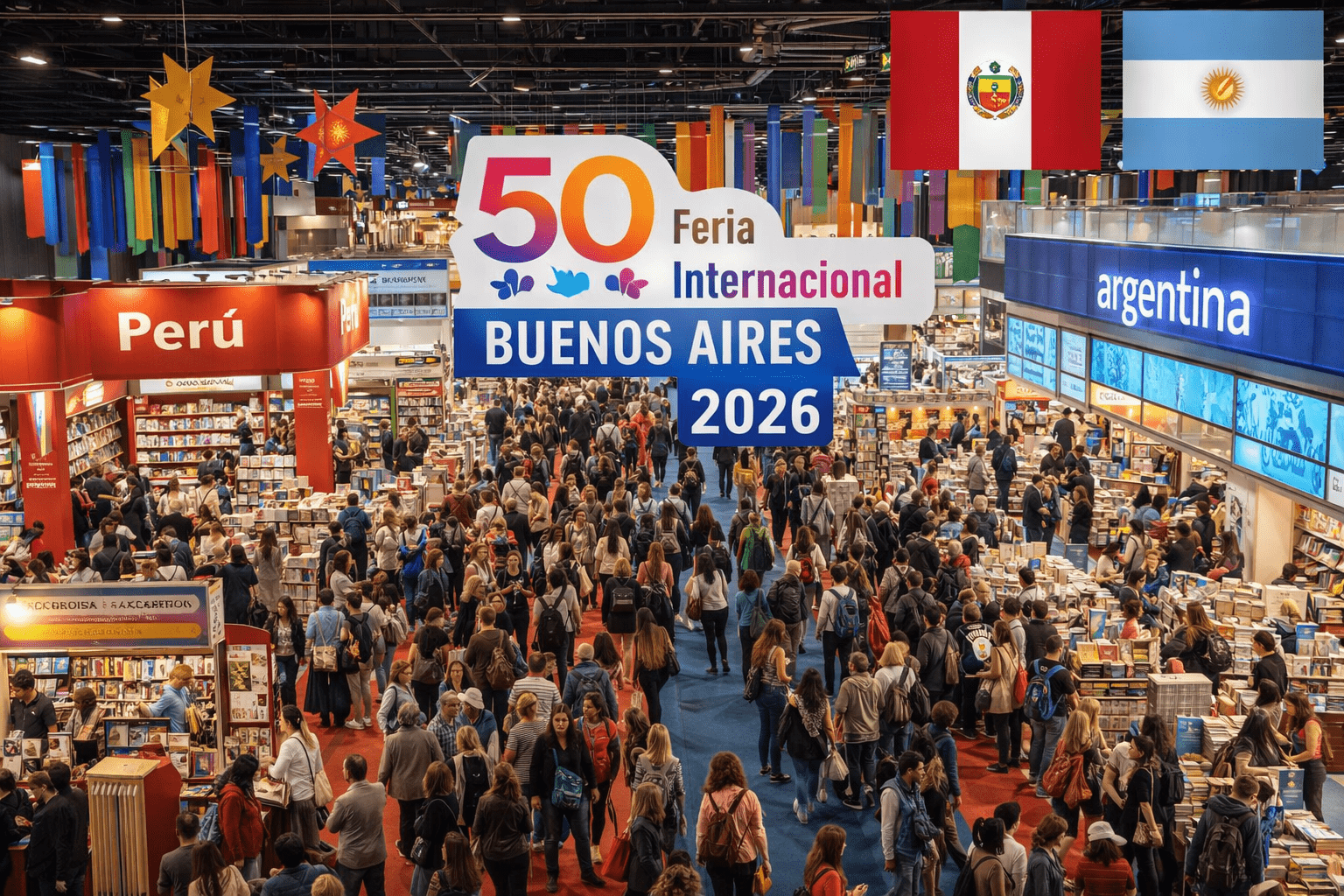
What happened
The 50th Buenos Aires International Book Fair will open its doors to the public from April 23 to May 11, 2026, at La Rural, the Buenos Aires Exhibition Center , with hours from 14 pm to 22 pm Monday through Friday and from 13 pm to 22 pm on Saturdays, Sundays, and holidays. The organizers present it as “the largest cultural event in Latin America” and announce a historic edition, with more than 45.000 m² dedicated to books and culture.
The official opening will be on Thursday, April 23, at 6:00 p.m. , but this time with a highly symbolic change: for the first time, the traditional opening speech will be replaced by a debate between Leila Guerriero, Selva Almada, and Gabriela Cabezón Cámara , moderated by María O'Donnell . In addition, there is another institutional change: the fair is abandoning the "guest city" designation and introducing the "guest country of honor" designation , a role that will be filled by Peru.
There is also a calendar detail worth clarifying. While the official website of the fair lists the public edition as running from April 23 to May 11 , official Peruvian documentation places that country's participation from April 21 to May 11. This difference doesn't appear to be a fundamental contradiction, but rather a consequence of the earlier start of the Professional Days , scheduled by the fair itself from April 21 to 23.
You may be interested in: Nicolás Maduro: youth and students.
Why does it matter
The cultural significance of this edition goes beyond its milestone anniversary. The fair reaches its fiftieth year by redefining two central aspects of its identity: who inaugurates the event and from what perspective its international projection is constructed. Replacing the opening monologue with a conversation between three contemporary Argentine writers suggests a shift from a single voice to a more collective performance. And choosing, for the first time, a guest country instead of a city broadens the geopolitical interpretation of the event: Buenos Aires is seen less as a local showcase and more as a platform for the Latin American publishing scene. This interpretation is reinforced by the role that the Peruvian government itself attributes to its presence at the fair: a tool for the internationalization of its publishing industry and the promotion of its bibliodiversity.
Context
The organizers have already announced a large-scale program, with more than 1.500 cultural events , and have emphasized an edition that combines memory, celebration, and innovation. Within this program, one theme stands out as particularly significant: the dialogue “50 Years of Reading and Writing in Argentina ,” conceived as a conversation about books as historical, political, and cultural practices, from the dictatorship to the present day. This is no small detail: instead of celebrating the anniversary as a mere commemoration, the fair seeks to interpret its own history within the context of the struggles surrounding reading, censorship, memory, and the circulation of ideas.
The Peruvian focus also deserves a broader interpretation than that of a mere formality. The Peruvian Ministry of Culture declared this participation a matter of national interest and defined it as a strategic platform to mobilize and position its publishing industry internationally. This commitment is embodied in a delegation composed of writers, editors, illustrators, and researchers , officially presented as a showcase of the diversity of the Peruvian book and reading ecosystem. In other words, Peru is not simply there to exhibit itself, but to negotiate cultural presence, rights, distribution, and regional visibility.
Meanwhile, the fair retains its professional marketplace dimension. The Professional Days , celebrating their 40th anniversary , will once again serve as a forum for business, rights, training, and international connections. The organizers highlight the active professional community, training activities, and offerings of Spanish-language rights with publishers from various countries. This aspect is often overshadowed by the programming for the general public, but it is crucial to understanding why the Buenos Aires Book Fair remains one of the most influential publishing hubs in the region.
Quick keys
- Dates of the fair open to the public: from April 23 to May 11, 2026.
- Location: La Rural, Buenos Aires Exhibition Center.
- Official opening: April 23, 18 p.m.
- New feature: debate between Leila Guerriero, Selva Almada and Gabriela Cabezón Cámara, with María O'Donnell.
- Guest of honor: Peru, the first time the fair has adopted the role of guest country.
- Scale of the event: more than 45.000 m² and more than 1.500 cultural events.
Whats Next
The fair will officially begin with the industry's professional activities between April 21 and 23 , and two days later it will fully open to the public with a ceremony that already marks a departure from previous editions. For a literary platform, the publishing opportunity lies not in repeating the agenda but in understanding what this edition is saying about the current state of Spanish-language books: more conversation than grandstanding, more Latin America than ceremony, and a growing attention to the cultural industry behind the massive event. In this respect, the 50th Buenos Aires Book Fair not only celebrates a history but also attempts to forge a new narrative about its place in the region.

Ricardo Auguste grew up immersed in Haitian culture and language, roots that permeate his sensibility and his worldview. Although he had no formal academic training in literature, from a young age he was self-taught, reading Haitian and international poets. Over time, he developed his own free and experimental voice, where introspection intersects with a strong social conscience. Among his works are Songes infects (2013), Plen-Pip (2014), Kout zegwi (2015), written in Creole and inspired by Haitian folk traditions, and Mil frases en mis brazos (2015), written in Spanish and focused on universal themes.