
Audiobooks: why listening to a story also counts as reading
For some readers, audiobooks remain a "lesser" way to engage with books. For others, they are the most practical way to read amidst work, commutes, fatigue, or visual difficulties.
The debate reveals a deeper question: does reading simply mean passing your eyes over a page, or does it also mean entering into a story, understanding it, imagining it, and remembering it?
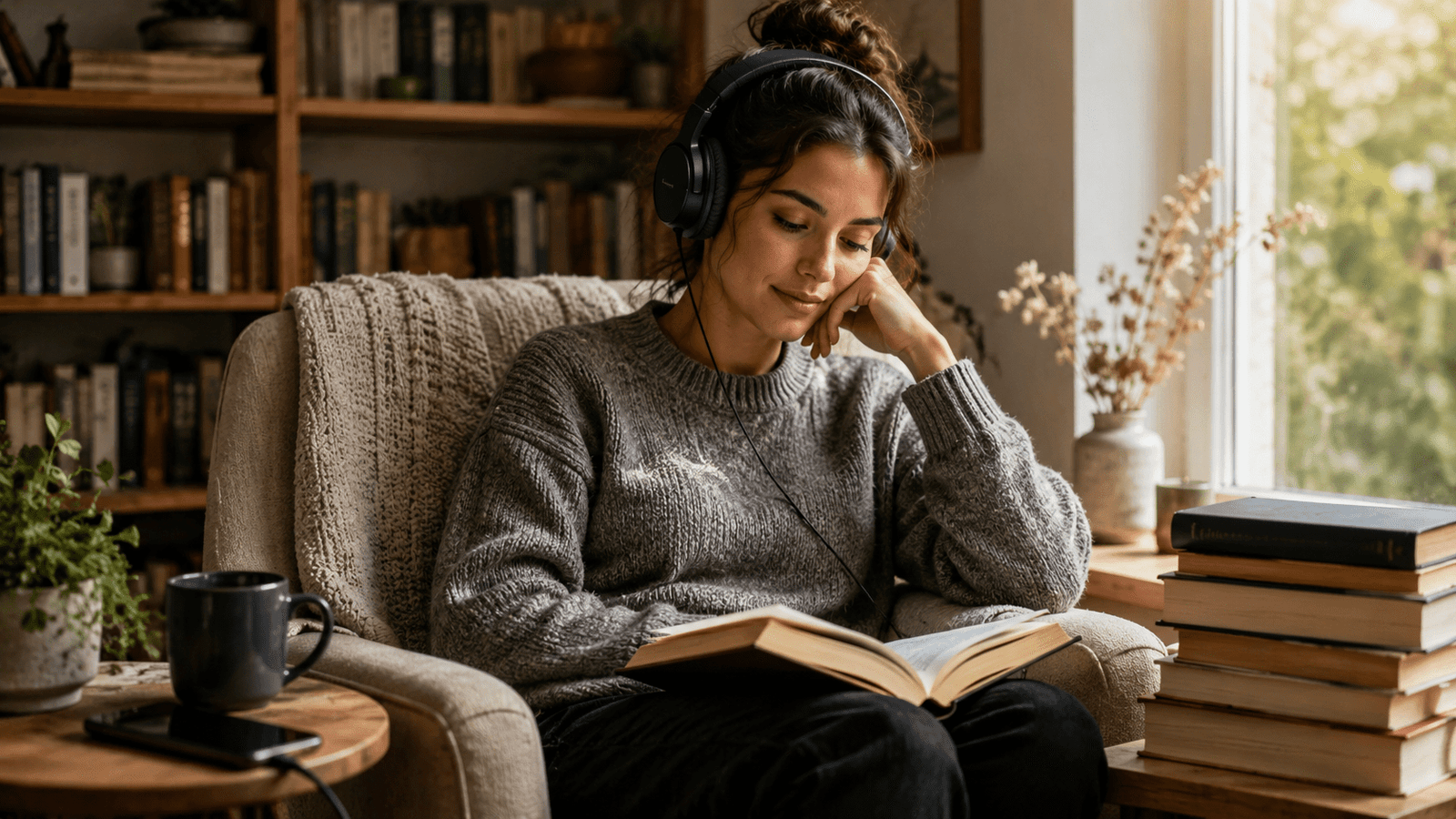
Listening to a book is not cheating
For years, many readers have viewed audiobooks with suspicion, as if listening to a novel were a convenient, incomplete, or less legitimate version of reading. The phrase "that doesn't count as reading" comes up again and again. But that reaction says more about our prejudices than about books themselves.
Listening to an audiobook requires attention, memory, imagination, and a knack for storytelling. The reader—or listener—follows a plot, recognizes characters, interprets tones, recalls scenes, and constructs mental images. The experience is different, of course: looking at a page is not the same as listening to a voice. But different doesn't mean inferior.
Literature was also born to be heard
Before becoming a silent, solitary practice, literature had a strong oral dimension. Stories, poems, epics, religious tales, plays, and folk narratives circulated for centuries through the spoken word. In that sense, the audiobook doesn't break with literary tradition; it recovers an ancient part of it.
The voice adds rhythm, pause, breath, and interpretation. A good narrator can illuminate dialogue, sustain the tension of a scene, or make a difficult work more accessible. They can also change the emotional relationship with the text: some books are understood differently when someone reads them with intention.
The rise of audiobooks is no longer a minor fad.
The growth of the format shows that the audiobook is now a central part of the publishing ecosystem. The Audio Publishers Association reported that audiobook sales revenue in the United States reached $2.220 billion in 2024 , a 13% increase over the previous year. The same organization noted that digital audiobooks accounted for 99% of the sector's revenue during that period. ( audiopub.org )
In the UK, The Guardian reported, based on data from the Publishers Association, that audiobook downloads increased by 17% between 2022 and 2023, while revenue grew by 24% to reach £206 million . ( theguardian.com )
This data doesn't mean that printed books are disappearing. Rather, it shows that reading habits are diversifying. Many people combine formats: they read on paper at home, listen to audiobooks while commuting, use ebooks while traveling, or alternate depending on their available time.
When reading with your eyes isn't the only option
One of the greatest values of audiobooks is accessibility. For people with visual impairments, physical difficulties, reading disorders, or conditions that prevent them from holding a printed book, audio is not just a convenience: it can be an essential gateway to literature.
The Library of Congress's National Library Service for the Blind and Print Disabled is a free audiobook and braille service for people with low vision, blindness, or physical, perceptual, or reading disabilities that make it difficult to read printed material. Its books and journals can be downloaded to personal devices or mailed free of charge within its system. ( loc.gov )
From that perspective, dismissing audiobooks as "lesser reading" ignores a key dimension: not all bodies read in the same way, and literature should be accessible through more than one channel.
The format that adapts to fast-paced lives
There are also readers without disabilities who turn to audiobooks for practical reasons: housework, walks, public transport, exercise, travel, eye strain, or lack of time. Audiobooks allow them to reclaim moments that previously seemed lost to reading.
This flexibility explains part of its appeal. A novel can accompany a walk. An essay can be listened to while cooking. A classic can be enjoyed through headphones during a long trip. It's not about replacing all books with audio, but about expanding the possibilities for engaging with them.
Audiobooks, childhood and new gateways to reading
Audiobooks also play a role in developing readers. The National Literacy Trust notes that audiobooks can support children's reading skills and offers resources for families and schools on how to use them in educational settings. ( literacytrust.org.uk )
This doesn't mean that listening should replace reading, especially when developing decoding skills. But it can complement the process: improving story comprehension, expanding vocabulary, sparking imagination, and making literature more accessible to students who struggle with written text.
The prejudice against listening to stories
Resistance to audiobooks often stems from a rigid idea: that reading is merely deciphering letters with your eyes. But the literary experience doesn't end there. Reading also involves understanding, imagining, connecting, remembering, interpreting, and discussing what you've read.
There are real differences between formats. On paper, you can underline, easily go back, and examine the structure of a page. In audio, on the other hand, the voice sets the pace and demands a different kind of attention. Each format gains and loses something. The question shouldn't be which is "purer," but which allows a person to truly engage with a book.
Keys to understanding why audiobooks also matter
- Listening to an audiobook requires attention, memory, and imagination.
- The audiobook recovers the oral dimension of literature.
- The format is growing strongly in markets such as the United States and the United Kingdom.
- For many people with visual impairments or reading difficulties, audio is an essential means of access.
- Audiobooks can complement the promotion of reading in families and schools.
- They do not replace the printed book: they expand the ways of reading.
What's coming: less purism and more paths to books
Audiobooks shouldn't be seen as a threat to reading, but rather as one of its contemporary forms. Some books will demand paper, silence, and a pencil. Others will work better in a narrator's voice. Some readers will alternate between both approaches depending on the moment.
Perhaps the debate isn't whether listening "counts" as reading, but why we need to so narrow our definition of reading. If a story stays with us, transforms us, makes us think, and remains in our memory, then perhaps literature has already done its job, even if it entered through our ears.

Jude Jacques is a poet, writer, and playwright with a strong background in business management. He teaches electricity at the Don Bosco Salesian Technical School, where he has over 15 years of experience training future electrical professionals. His work combines the humanistic perspective of the arts with the rigor of technical education, bringing a unique perspective both in the classroom and in his creative projects.